Size Guide
Every IBC dimension, in one honest reference.
Planning floor space, racking, or freight? Here are the real numbers — capacities, footprints, heights, weights, and outlets — plus the field notes that actually matter.
Quick answer: The two standard IBC totes are 275 gal (40×48×46 in) and 330 gal (40×48×53 in). Both share the same 40×48-inch pallet footprint; the 330 is taller for more volume per floor tile.
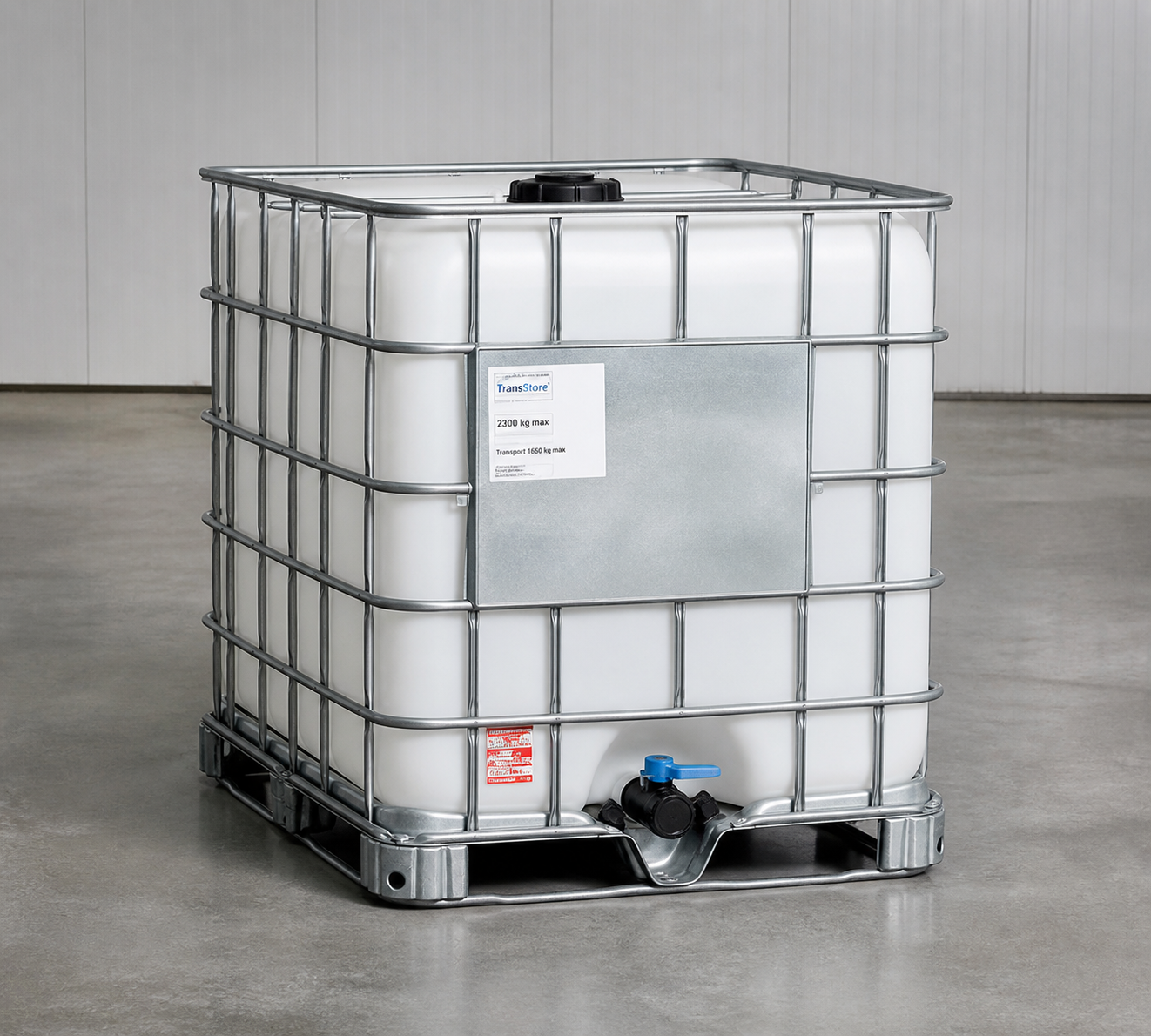
The master table
Capacities, footprints & weights.
| Capacity | Footprint | Height | Empty weight | Outlet | Notes |
|---|---|---|---|---|---|
| 275 gal (1,040 L) | 40 × 48 in | 46 in | ≈ 125 lb | 2" NPT | The most common IBC. Fits a standard GMA pallet footprint. |
| 330 gal (1,250 L) | 40 × 48 in | 53 in | ≈ 145 lb | 2" NPT | Same footprint as 275, taller cage — more volume per floor tile. |
| 120 gal (450 L) | 40 × 48 in | 28 in | ≈ 95 lb | 2" NPT | Low-profile bin for dense liquids and height-restricted areas. |
| 550 gal (2,080 L) | 48 × 48 in | 60 in | ≈ 320 lb | 3" NPT | High-volume steel format for bulk programs. |
Weights and heights are typical for caged composite totes and vary slightly by manufacturer.
Metric & imperial
Capacity across the full size range.
Beyond the two standards, we handle compact 120 gallon bins and oversize 550 gallon totes. Here is every capacity in gallons, liters, and cubic meters for planning that crosses unit systems.
| US gallons | Liters | Cubic meters | Where it fits |
|---|---|---|---|
| 120 gal | 454 L | 0.45 m3 | Compact half-height bin for tight cells and low-clearance mezzanines. |
| 275 gal | 1,041 L | 1.04 m3 | The global standard IBC — the format most equipment is built around. |
| 330 gal | 1,249 L | 1.25 m3 | Same footprint, taller bottle — roughly 20 percent more volume per floor tile. |
| 550 gal | 2,082 L | 2.08 m3 | Oversize bin for bulk holding; confirm forklift capacity and rack ratings first. |
Filled weights
What common liquids actually weigh in a tote.
Volume decides floor space; weight decides stacking and freight. These are estimated filled weights by liquid density — always verify against your own rack and floor ratings.
| Liquid | Filled 275 gal | Filled 330 gal | Field note |
|---|---|---|---|
| Water (SG 1.00) | ~2,375 lb | ~2,875 lb | Baseline. Empty tote plus liquid at one kilo per liter. |
| Light oils (SG ~0.90) | ~2,175 lb | ~2,625 lb | Many lubricants and vegetable oils sit just under water. |
| Glycol / antifreeze (SG ~1.11) | ~2,600 lb | ~3,150 lb | Denser than water — recheck rack limits before stacking. |
| Concentrated acids (SG ~1.40) | ~3,225 lb | ~3,925 lb | Heavy. Often the weight, not the volume, caps how high you stack. |
Estimates assume a full tote plus roughly 140 lb of empty tote. Water weighs about 8.34 lb per gallon.
Stacking & clearances
Height math for doors, racks & sprinklers.
Before you stack, confirm three numbers: cage stack rating, filled weight against your rack, and the overhead clearances below. A tote that fits the floor can still fail the ceiling.
Two full 330s plus the base clear about 106 in — too tall for a low dock door.
Standard dock door
A single 330 (about 53 in) clears easily; a double-stack (about 106 in plus pallet) will not fit a low door.
Warehouse aisle & rack
The 40 by 48 in footprint drops into a standard pallet position; leave a few inches per side for the cage.
Overhead sprinkler clearance
Fire code wants clear space beneath sprinklers — plan stack height so the top tote stays under it.
Fill / draw access
Leave room for a pump, hose, and drip pan at the bottom outlet, plus top-cap reach for filling.
Freight & floor planning
Plan by the pallet, not the gallon.
How many totes fit a 53' trailer?
About 20 caged totes floor-loaded single-high, or up to ~40 double-stacked when contents and cages allow. A full truckload with us is 40+.
Do 275 and 330 totes share a footprint?
Yes — both sit on the same 40 × 48-inch GMA pallet base. The 330 is simply taller, so you get more volume in the same floor space.
How much does a filled tote weigh?
A water-filled 275 approaches ~2,400 lb; a 330 nears ~2,900 lb. Always check rack and floor ratings before stacking.
Loading math
LTL, FTL & the 53-foot trailer.
With dense liquids, the payload ceiling caps your count before the floor does. A single LTL pallet ships one or two totes; anything past roughly six pallets usually pencils out cheaper as a full truckload.
How to measure
Get your own numbers in five steps.
Fitting totes into an existing space or line? Measure it yourself with this checklist before you order, so the tote lands, connects, and stacks the first time.
Measure the pallet base first — it is nearly always 40 by 48 inches, the number racking and freight are planned around.
Take overall height from the ground to the top of the cage or cap, whichever is taller, not just the bottle.
Note the outlet height and thread so your pump and drip pan line up with the valve, not the floor.
Add a tolerance of about half an inch to an inch per dimension — cages and pallets vary slightly between manufacturers.
For double-stacking, multiply the single height by two and add the base thickness, then compare to your door and sprinkler clearances.
275 vs 330
Same base. More gallons. Easy choice for volume.
Because they share a footprint, high-volume users default to the 330 — you buy ~20% more capacity on the same floor tile and the same freight slot. Choose the 275 when fill height, door clearance, or dense liquids cap your weight first.
330 gal = ~20% more liquid, 0% more floor space.
Size guide FAQ
Dimension & freight questions, answered.
What are the exact dimensions of a 275 gallon IBC tote?
A standard 275 gallon caged composite tote is about 40 inches wide by 48 inches deep by 46 inches tall, on a 40 by 48 inch pallet base. Expect a tolerance of roughly half an inch to an inch by manufacturer.
How much bigger is a 330 gallon tote than a 275?
It holds about 20 percent more liquid. The footprint is identical at 40 by 48 inches; the 330 is simply taller, around 53 inches versus 46, so it fits the same pallet position and freight slot with more volume.
How do I calculate the filled weight of a tote?
Take the empty tote weight (roughly 130 to 150 lb) and add the liquid weight — gallons times 8.34 lb times the liquid specific gravity. Water in a 275 lands near 2,375 lb; denser liquids climb from there.
Can IBC totes be safely stacked?
Many caged totes are rated to stack two or three high when full, but the limit depends on cage condition, liquid density, and your rack or floor rating. Never stack damaged cages, and always confirm the lower tote is rated for the load above.
How many totes fit on a standard 53 foot trailer?
About 20 totes floor-loaded single-high, or up to roughly 40 double-stacked when the cages and contents allow. Weight often becomes the limit before floor space with dense liquids, so check the trailer payload rating too.
Do totes fit standard warehouse racking?
Yes. The 40 by 48 inch GMA footprint drops straight into a standard pallet position. Confirm your beam height accommodates the tote height plus a lifting clearance, and that the rack is rated for the filled weight.
What clearance do I need to fill and drain a tote in place?
Plan for about 24 to 36 inches of open access at the bottom outlet for a pump, hose, and drip pan, plus overhead reach to the top cap for filling. Keep the top of any stack at least 18 inches below sprinkler heads.
Go deeper
Size & spec articles.
IBC Tote Dimensions Explained: Every Size, Spec & Footprint
The complete reference on IBC tote sizes — 275 vs 330 gallon, footprints, heights, weights, and how to plan your floor space and freight.
Read →6 MIN READFood-Grade IBC Totes: What Qualifies and How to Verify
What actually makes an IBC tote food-grade, how reconditioners verify it, and the questions to ask before you fill one with anything edible.
Read →8 MIN READ27 Clever Ways to Repurpose an IBC Tote
From rainwater harvesting to aquaponics and dock floats — the most useful second lives for a retired IBC tote, and which grade you need for each.
Read →