Tote Types

Every IBC format, matched to your liquid.

From the workhorse caged composite to stainless closed-loop bins, here's the full range we source, recondition, and stock — with the honest best-use for each.

Quick answer: The main IBC tote types are caged composite (275/330 gal), food-grade, rebottled (new bottle + reused cage), insulated/heated, stainless steel, and UN/DOT hazmat-rated totes.

Get a fast, written quote — no phone required.

US ZIP (44017 or 44017-1234) or Canada (A1A 1A1)
US/Canada number, e.g. (216) 555-0123

No phone spam — we reply by email. Your details stay with us.

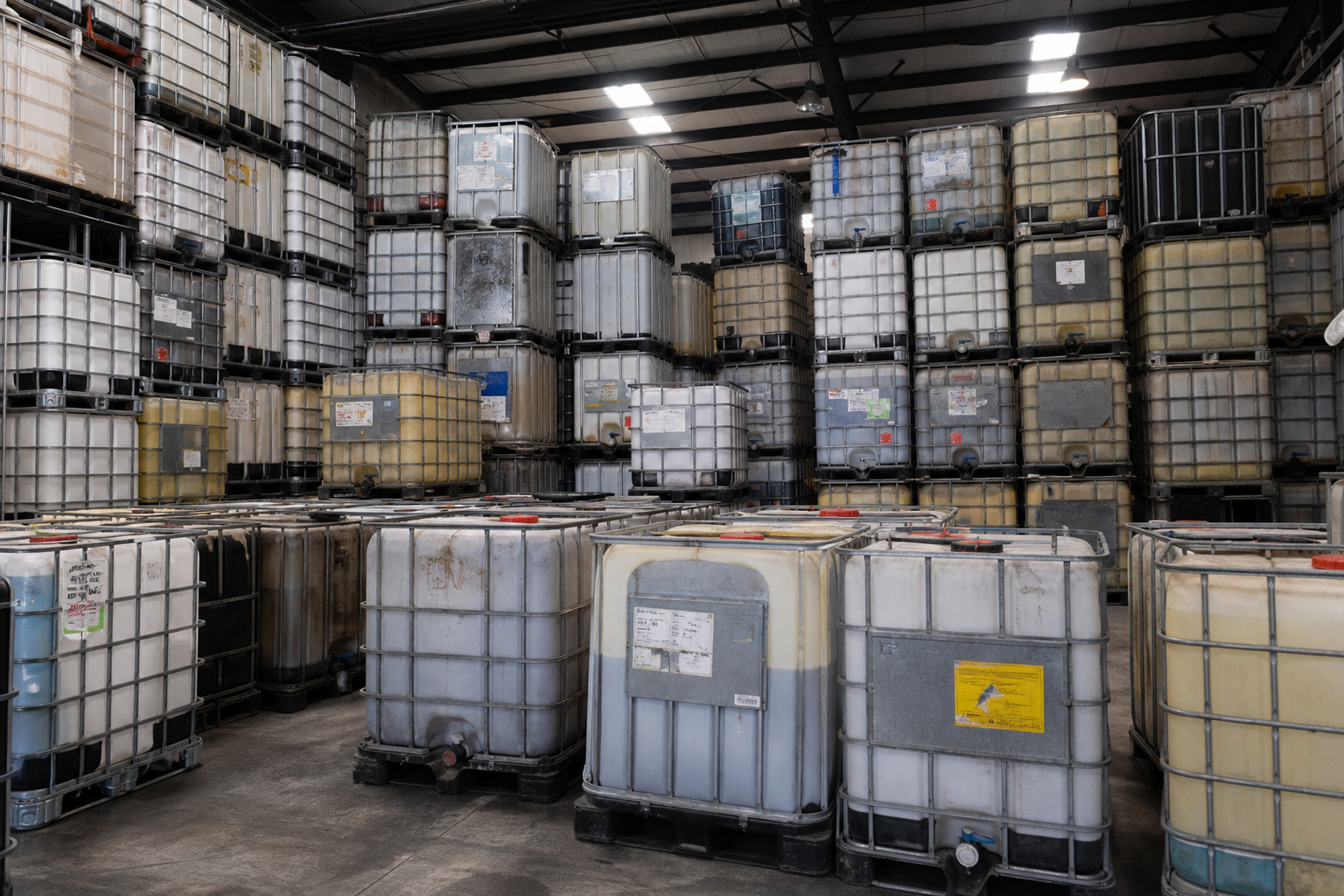
A large indoor inventory of caged IBC totes in many grades
275 & 330 gal

Caged Composite IBC

Best for: General liquids, chemicals, water

The workhorse. An HDPE inner bottle cradled in a galvanized-steel cage on a pallet base. The format 90% of the industry runs on — and the one we recondition by the thousand.

  • HDPE bottle, galvanized tubular cage
  • 2" NPT ball or butterfly valve
  • 6" fill cap, UN/DOT markings available
  • Stackable 3-high loaded
Check availability →
275 & 330 gal

Food-Grade IBC

Best for: Beverages, syrups, edible oils, brewing

Totes whose only prior life held food-safe contents, then triple-rinsed and documented. FDA-compliant virgin HDPE, traceable prior-product history.

  • Verified food-only prior contents
  • Triple-rinsed + wash certificate
  • FDA 21 CFR HDPE resin
  • EPDM gaskets available on request
Check availability →
275 & 330 gal

Rebottled IBC

Best for: When you want new-bottle purity at a reused price

A brand-new HDPE bottle dropped into a reconditioned cage and pallet. The sweet spot between fully new and fully used — pristine interior, circular frame.

  • Factory-fresh inner bottle
  • Reconditioned steel cage & pallet
  • No prior-contents concern
  • Lower cost + lower footprint than all-new
Check availability →
275 & 330 gal

Insulated & Heated IBC

Best for: Viscous or temperature-sensitive liquids

Totes wrapped with insulating jackets or fitted with band/immersion heaters to keep waxes, resins, and food products flowing through cold months.

  • Removable insulating jackets
  • 110V / 240V heater options
  • Thermostatic controllers
  • Freeze-protection for winter storage
Check availability →
110 – 550 gal

Stainless Steel IBC

Best for: Solvents, flammables, high-purity, repeat use

304/316 stainless bins for aggressive chemistries, high-purity processes, and closed-loop programs where a tote runs hundreds of cycles instead of a handful.

  • 304 / 316L construction
  • Pressure & vacuum rated options
  • CIP-ready, decades of service life
  • The ultimate reusable format
Check availability →
275 & 330 gal

UN/DOT Hazmat IBC

Best for: Regulated & hazardous liquids

Totes carrying valid UN31HA1 / 31HA2 rating plates for shipping regulated goods, with documented pressure-test dates and compliant fittings.

  • Valid UN rating plate
  • 2.5-year & 5-year retest tracking
  • Compliant EPDM/Viton seals
  • Placarding guidance included
Check availability →

Selection guide

Start with the liquid, land on the type.

The single best predictor of the right tote is what goes inside it. Match your product to the row below, then we'll confirm gaskets, grade, and fitment before anything ships.

Your liquidRecommended typeWhy
Water, brines & non-hazardous cleanersReconditioned caged composite (Grade A)The cheapest, greenest fit. A washed HDPE bottle handles neutral water-based liquids for years with no chemical concern.
Food, beverage & sanitary ingredientsFood-grade or rebottled with a new bottleYou need a documented prior contents history or a virgin FDA-compliant HDPE bottle. Never trust a wash alone for edible product.
Fuels, solvents & flammablesUN/DOT hazmat-rated caged toteShipping regulated liquids requires a valid UN marking, current retest date, and compatible gaskets — not a generic bin.
Acids, caustics & aggressive chemistryCaged HDPE with Viton seals, or stainlessHDPE resists most acids and bases well; upgrade the valve and cap gaskets to Viton. Stainless suits oxidizers and high temps.
Hot-fill, viscous or temperature-held productInsulated / heated jacketed toteA jacket plus a band or blanket heater holds resins, syrups, and waxes pumpable through cold storage and winter transport.
High-purity or closed-loop reuseStainless steel IBCFully cleanable, non-permeable, and reusable for decades — the lowest lifetime footprint where cross-contamination is unacceptable.

Materials science

What the bottle, cage & base are actually made of.

Understanding the materials tells you where a tote shines and where it needs help. Here's the honest engineering behind the format.

Why HDPE is the workhorse bottle

High-density polyethylene is chemically inert to a huge span of water-based and many solvent chemistries, food-safe in virgin form, and light enough to keep filled weight and freight cost down. Its blow-molded seamless wall has no joints to fail.

Permeation & UV are the real limits

HDPE is slightly permeable to some hydrocarbons and oxygen over long storage, and unstabilized resin chalks in direct sun. We steer outdoor and long-hold applications toward carbon-black or foil-jacketed bottles, or stainless.

The galvanized cage does the lifting

The tubular steel grid carries stacking and forklift loads so the thin bottle never has to. Hot-dip galvanizing resists rust; we straighten, re-weld, and re-galvanize touch-up damaged cages rather than scrap them.

Pallet base options

Bases come as composite (plastic) for washdown and food areas, steel for heavy racking, or wood for lowest cost. The 40 by 48 inch footprint is standard across all three so handling gear never changes.

Fitment options

Valves, adapters & caps that match your line.

The tote format is only half the spec — the outlet and top cap decide whether it connects to your pump on day one. These are the fitment choices we set up during reconditioning.

Tell us the coupling on your hose. We'll spec the outlet to match.

Butterfly valve

The default 2 inch bottom outlet. Quarter-turn, high flow, easy to gasket-service. Our reconditioning standard replacement.

Ball valve

Better fine-flow control and a tighter shutoff for thinner liquids; slightly higher restriction than a butterfly.

Camlock adapter

Cam-and-groove quick-connect for pumps and transfer hoses — snap on, lever down, done. Sizes to match your line.

Garden-hose (GHT) adapter

Threads a standard hose onto the outlet for gravity draining rinse water, non-critical fluids, and irrigation.

NPT bushing

Steps the coarse buttress outlet thread down to tapered pipe thread for permanent plumbing into a process line.

Vented / solid caps

Top lids in vented (equalizes pressure during draw-down) or solid sealed for transport and vapor control.

Type meets grade

How condition grading layers on top of format.

Format and grade are two separate axes. A caged composite can be Grade A, Grade B, or rebottled; the type tells you the design, the grade tells you the condition and prior life.

TypeGrades availableWhat to know
Caged compositeGrade A, Grade B, or rebottledThe most graded family — condition and prior contents drive price more than the format itself.
Food-gradeGrade A with clean prior-contents historyOnly ex-food or virgin bottles qualify; a Grade B cosmetic mark can still be food-grade inside.
RebottledNew bottle on a reconditioned cageEffectively new inside, reused steel outside — near-virgin performance at a lower footprint and price.
Stainless steelNot applicable — cleaned & testedJudged by seam integrity, gasket condition, and pressure test, not the plastic grading scale.

See grades explained in full →

By the numbers

The range, at a glance.

0+Core tote formats stocked
0Smallest standard gallons
0Largest standard gallons
0"Standard bottom outlet

Buying tips

Six things to settle before you order.

01

Lead with the liquid, not the format. Tell us the product, concentration, and temperature and the correct type usually picks itself.

02

Confirm gasket material. EPDM is the standard; Viton is worth the upgrade for solvents, fuels, and aggressive chemistry.

03

Check the outlet you actually connect to. A mismatch between your pump fitting and the tote valve is the most common day-one surprise.

04

For shipping regulated goods, verify the UN marking and retest date before you buy — an expired hazmat tote cannot legally move.

05

Buying rebottled beats buying new. You get a virgin bottle without paying for a new cage and pallet the planet does not need.

06

Order caps and spare gaskets with the totes. A one-dollar seal ordered up front saves a leaking tote and a return trip later.

Tote type FAQ

Common questions on formats & fit.

What is the difference between a caged composite and a rebottled IBC?

A caged composite tote is a blow-molded HDPE bottle inside a galvanized steel cage on a pallet base — the standard format. Rebottled means we put a brand-new bottle into a reconditioned cage and base, so the wetted surface is virgin while the steel is reused.

Can I store any chemical in a standard HDPE IBC tote?

HDPE handles most water-based liquids, many acids and bases, and a wide range of chemistries, but not everything. Strong oxidizers, certain aromatic solvents, and high-temperature product may need a Viton-sealed or stainless tote. Share your product and we will confirm compatibility.

How do I know if a tote is truly food-grade?

A genuinely food-grade tote has either a virgin FDA-compliant HDPE bottle or a documented history of holding only food-safe prior contents, plus a proper wash. A cosmetic scuff on the cage does not affect food-grade status; prior contents and cleaning do.

Do 275 and 330 gallon totes come in every type?

Most types are offered in both capacities because they share the same 40 by 48 inch footprint. Availability of specialty formats such as stainless or insulated varies by capacity, so ask and we will tell you what is in stock or sourceable.

What makes an IBC UN/DOT hazmat rated?

A hazmat-rated tote carries a molded or plated UN marking that certifies its design was tested for a defined packing group and specific gravity, and it stays valid only within its retest interval. Shipping regulated liquids in an unmarked or expired tote is not permitted.

Is insulated the same as heated?

No. Insulation is a passive jacket that slows temperature loss; heating adds an active band or blanket element to raise or hold temperature. Many viscous-product users pair both to keep resins and syrups pumpable through winter.

Which tote type is the most sustainable choice?

Reuse always wins. A reconditioned Grade A caged tote has the lowest footprint for compatible liquids; rebottled is next for jobs needing a virgin surface; stainless is best for long-term closed-loop reuse. New plastic should be the last resort.

Can you match a valve or adapter to my existing equipment?

Yes. Tell us the thread or coupling on your pump, hose, or process line — NPT, camlock, garden-hose, or buttress — and we will spec the outlet, adapter, and gaskets so it connects on the first try.

Not sure which?

Tell us the liquid — we'll spec the tote.

Share your product, volume, and grade needs and we'll recommend the greenest option that fits.

Get a Quote