Sustainability
This isn't a green section. It's the whole business.
Most companies bolt sustainability onto the side. For us, reuse is the product. Here's the environmental logic — and the numbers — behind everything we do.
Quick answer: Reusing one caged IBC tote instead of making a new one avoids roughly 122 kg CO₂e, 980 L of water, and 12 kg of virgin plastic. We reuse first, repurpose second, recycle last — with a zero-to-landfill goal.
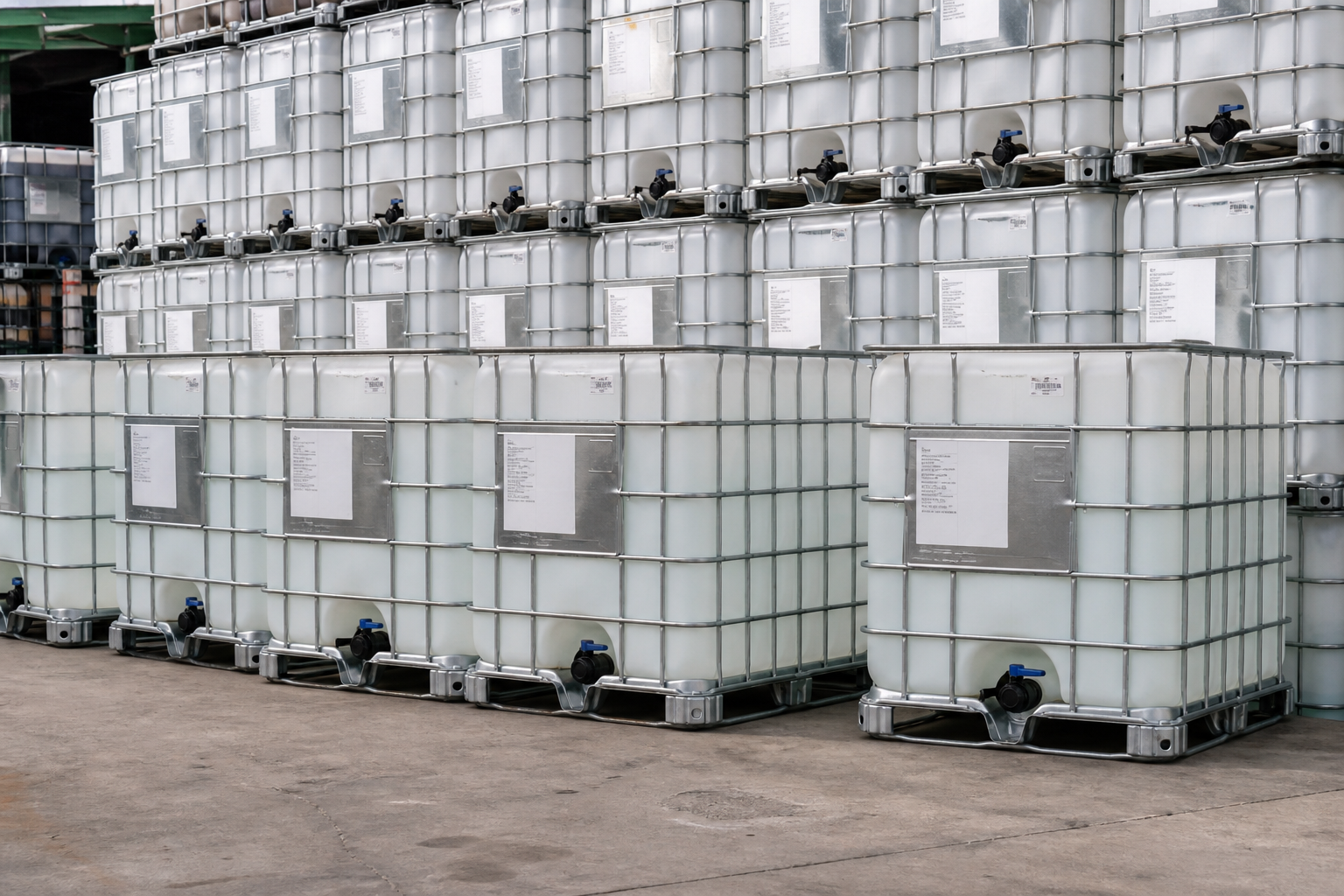
Per-tote savings
The footprint you avoid, every single tote.
Our hierarchy
Four pillars, in strict order of preference.
Reuse first
Every recovered tote we can return to service is one we don't manufacture. Reuse avoids the entire production footprint — not just the disposal end.
Repurpose second
Totes past liquid duty become rain harvesters, planters, and dock floats — extending their life by a decade before any material is reprocessed.
Recycle last
Only at genuine end-of-life. HDPE is ground and re-pelletized; steel goes to metal recovery. Recycling is our safety net, not our plan A.
Report honestly
We provide diversion documentation you can drop straight into ESG and scope-3 reporting. Real numbers, not vague green claims.
The hierarchy in depth
Why the order is not negotiable.
Reuse, repurpose, recycle is not a slogan we picked for the rhyme — it is a strict ranking by environmental cost, and we hold to it even when a lower rung would pay us more.
Reuse
Keeping a tote whole and working avoids the entire remanufacture step — the resin, the steel, the assembly, and the disposal. Nothing beats a tote that simply keeps doing its job.
Repurpose
When a tote can no longer hold a commercial fill, it can still hold rainwater, soil, or gear. Repurposing extracts a full second life before any material is ground down.
Recycle
Only at true end-of-life. Re-pelletizing HDPE and recovering steel still burns energy, so we treat it as the safety net that guarantees nothing is buried — never as the goal.
Lifecycle of a tote
From first fill to material recovery.
A linear tote is made, used once, and buried. A circular tote follows a longer, greener path — here is each stage of the life we design for.
First fill
A tote is manufactured and filled by a producer. Most of its lifetime carbon and water footprint is spent right here, on day one.
Recovery
Instead of the empty becoming a disposal cost, we buy and recover it — the moment a linear life could bend into a loop.
Reconditioning
Wash, inspect, repair, regrade. The tote returns to service for a fraction of the footprint of making a new one.
Second, third, fourth life
A caged IBC is built for a decade-plus. Each reuse cycle repays the original embodied energy again and again.
Repurposing
When it retires from liquid duty, the tote becomes rain storage, a planter, a float, or on-site containment — a whole extra life.
Material recovery
Only at true end-of-life: HDPE is ground and re-pelletized, steel goes to metal recovery. Nothing is buried.
Savings that scale
Per tote, per hundred, per thousand.
The per-tote figures are meaningful on their own, but the point of a fleet is that they multiply. Here is what reuse avoids as your program grows.
| Metric | Per tote | Per 100 | Per 1,000 | Basis |
|---|---|---|---|---|
| CO₂e avoided | ~122 kg | ~12.2 tonnes | ~122 tonnes | Skipped resin production, steel forming, and cage assembly. |
| Water saved | ~980 L | ~98,000 L | ~980,000 L | Water intensity of virgin HDPE and steel manufacture. |
| Virgin plastic avoided | ~12 kg | ~1.2 tonnes | ~12 tonnes | HDPE never extracted, refined, or molded. |
| Landfill diverted | ~118 kg | ~11.8 tonnes | ~118 tonnes | Full unit weight kept in service instead of buried. |
ESG & reporting
Turn reuse into numbers you can report.
Sustainability that cannot be measured is just a story. We build the documentation so your reuse becomes a line in the report, not a claim in a brochure.
Scope-3 support
Reused packaging reduces upstream (category 1) emissions. We hand you tote-level reuse figures to feed that calculation directly.
Diversion documentation
Every recovered and reconditioned tote is a documented landfill diversion — reportable weight, not a rounding error.
Audit-ready records
Grade sheets, prior-contents history, and recovery counts are structured to survive an ESG or sustainability audit.
Circularity metrics
Track units kept in the loop, buyback rates, and reuse cycles — the metrics circular-economy reporting frameworks ask for.
Do the math yourself
Your program, quantified.
Enter the number of totes you'd reuse and see the impact — the same engine our customers use to build their ESG story.
Estimates based on the HDPE + galvanized-steel footprint of a caged IBC. Reuse keeps the whole assembly working instead of manufacturing it twice.
Where we're headed
Commitments we hold ourselves to.
Nothing to landfill
Our standing goal is zero. If a tote can be reused or repurposed, burying it is off the table — and we would rather earn less recycling one than send it to a dump.
Recover more empties
Every empty we intercept before it becomes waste is the front door of the loop. Growing recovery is how we scale the environmental benefit.
Grow rebottling
Rebottling lets even virgin-interior applications ride a circular cage — expanding reuse into markets that used to demand fully new totes.
Make reporting effortless
We want the diversion data to be so clean that putting reuse into an ESG report is a copy-paste, not a research project.
Green glossary
The terms behind the scorecard.
Sustainability language gets slippery. Here is exactly what we mean by the words on this page.
| Term | What it means here |
|---|---|
| Circular economy | An economic model where products and materials are kept in use as long as possible, rather than the make-use-dispose linear model. Our whole loop is built on it. |
| Embodied energy | The total energy consumed to produce a product — for an IBC tote, resin production, steel forming, and assembly. Reuse repays it many times over. |
| Scope-3 emissions | Indirect emissions across a company's value chain, including purchased goods. Reused packaging lowers this category directly. |
| Landfill diversion | Waste redirected away from landfill through reuse, repurposing, or recycling. Every recovered tote counts as diverted weight. |
| Reconditioned | A recovered tote cleaned, inspected, and repaired for reuse of the original bottle — restored to spec and graded. |
| Rebottled | A new HDPE bottle paired with a reconditioned steel cage — virgin-interior purity on a circular frame. |
| Re-pelletizing | Grinding end-of-life HDPE into pellets for remanufacture. The recycling step of last resort in our hierarchy. |
| Zero-to-landfill | A commitment to send nothing to landfill by exhausting reuse, repurpose, and recycle options first. |
Zero to landfill
Our standing goal: nothing wasted.
When a tote truly can't be reused or repurposed, we recover the HDPE and steel rather than bury it. We'd rather earn less on a recycled tote than send anything to a landfill.
Sustainability FAQ
The environmental questions we get asked.
How much does reusing one tote actually save?
Reusing one caged IBC tote instead of manufacturing a new one avoids roughly 122 kg CO₂e, 980 L of water, and 12 kg of virgin plastic, and diverts about 118 kg from landfill. The savings come almost entirely from skipping production, which is where most of a tote's footprint lives.
Why is reuse better than recycling?
Recycling still burns energy to grind and re-pelletize material and reforge steel. Reuse keeps the tote whole and working, avoiding the entire remanufacture step. That is why our hierarchy is reuse first, repurpose second, and recycle only at true end-of-life.
Can I use your numbers in ESG or scope-3 reporting?
Yes. We provide tote-level diversion and reuse documentation designed to drop straight into ESG and scope-3 (category 1) reporting. They are real figures tied to real units, not vague green claims.
What happens to a tote that truly can't be reused?
At genuine end-of-life we recover the materials: HDPE is ground and re-pelletized and the steel cage goes to metal recovery. This is our safety net, not our plan A — but it means nothing is buried.
What does repurposing look like?
Totes retired from liquid duty become rain harvesters, planters, dock floats, and on-site storage or containment. Repurposing adds roughly a decade of life before any material is ever reprocessed.
Is the zero-to-landfill goal real or marketing?
It is a real operating discipline. We prioritize reuse and repurposing over the faster money of scrap, and we track diversion so the commitment is measurable rather than a slogan.
How do freight and logistics factor into the footprint?
Transport adds some carbon, but it is small next to the production footprint avoided by reuse. We consolidate truckloads on efficient regional lanes to keep both per-tote cost and per-tote carbon low.