FAQ
Straight answers, no fluff.
The questions we hear most from first-time and repeat customers. Don't see yours? Use the form above or email us — we reply fast.
Quick answer: Used IBC totes are safe when properly reconditioned; reconditioned units cost 40–65% less than new; we buy back your empties and ship across the contiguous USA. We operate by email — no phone line.
Start here
The most common questions.
Are used IBC totes safe to reuse?
Yes — when they're properly reconditioned. Every tote we sell is drained, triple-rinsed or hot-washed to its grade, and inspected. Food-grade totes carry verified prior-contents history and a wash certificate. For any application, we tell you exactly what a tote last held.
What's the difference between Grade A and food-grade?
Grade A describes cosmetic and structural condition — a clean, sound tote with a good cage and clear bottle. Food-grade is about contents history and cleaning: the tote only ever held food-safe products and has been rinsed and documented for edible use. A tote can be both. See our Grades Explained guide for the full breakdown.
Do you sell new IBC totes too?
We do, occasionally, and we offer 'rebottled' totes — a brand-new HDPE bottle in a reconditioned cage — which give you new-bottle purity at a lower price and a fraction of the footprint. We'll always steer you to the greenest option that meets your spec.
How much can I save buying reconditioned vs new?
Reconditioned caged totes typically run 40–65% less than a comparable new tote, depending on grade and volume. Rebottled totes land in between. Volume and repeat programs push savings higher.
Will you buy my used totes?
Almost always. If they're empty and drained, we'll quote them — single totes to full truckloads — and arrange pickup. It's the fastest way to clear dock space and keep totes in the circular loop.
Where do you ship?
We ship throughout the contiguous United States from our Berea, Ohio hub, on our own trucks for regional runs and via freight carriers nationwide.
How do I get a quote — is there a phone number?
We run lean and paperless, so we don't operate a phone line. The fastest path is the quote form on any page or an email to info@ibctotessolutions.com. We reply quickly, in writing, with everything documented.
Buying
Ordering reconditioned totes.
What comes standard on a caged composite tote I buy?
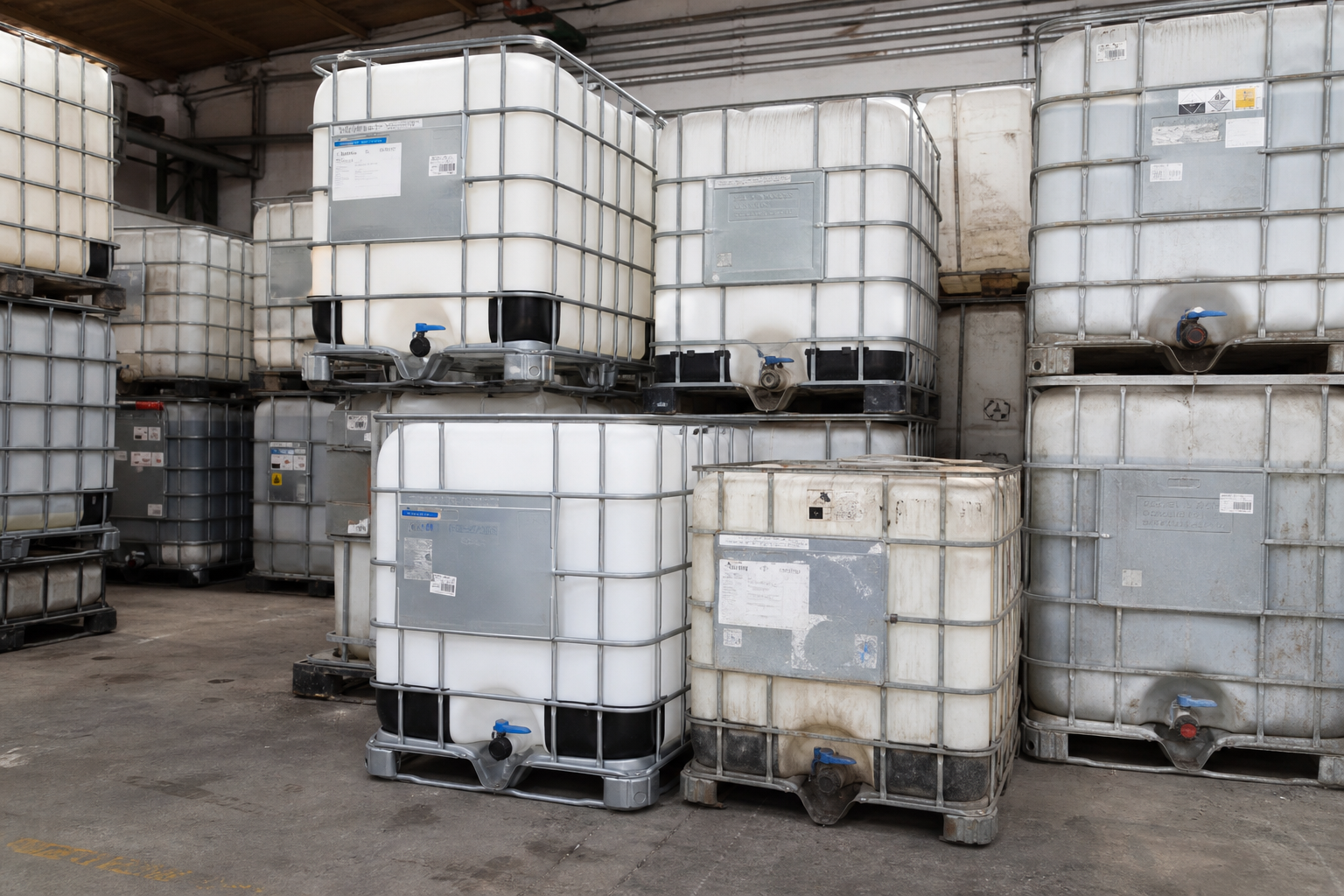
A 275 or 330 gallon HDPE inner bottle in a galvanized steel cage on a pallet base, with a 2-inch NPT bottom outlet (ball or butterfly valve) and a 6-inch fill cap. Both sizes share a 40 by 48 inch footprint. Fittings, gaskets, and cap style can be specified per order.
Can I order just one tote, or do I need a full load?
Either. We sell from a single tote up to a full truckload of 40-plus. Single totes and small quantities usually travel by LTL freight; larger orders move by full truckload, often on our own trucks for regional runs.
How fresh is your inventory — will totes have odor or residue?
Every tote is drained, washed to its grade, inspected, and photographed before it ships. Grade A totes are clean and sound; food-grade and rebottled units are the choice when odor and residue must be zero. If anything about a specific tote is off-spec, we tell you before you commit.
Do you provide UN/DOT rated totes for regulated liquids?
Yes, when available we can supply totes carrying a valid UN rating plate with documented retest dates and compliant seals. Tell us your product and packing group and we will match a compliant tote and share placarding guidance.
Selling
Buyback & clearing your dock.
What condition do my totes need to be in to sell?
They need to be empty and drained. Beyond that we consider a wide range of conditions and grades — even totes with tired bottles can be candidates for rebottling or recycling. Photos and the last-held product help us quote faster and firmer.
Do I have to load the totes myself?
No. We arrange pickup and handle the lifting. For qualifying quantities we bring the truck to your dock, so clearing idle totes is genuinely hands-off on your end.
How fast do I get paid?
We price the lot up front, schedule a pickup window that fits your dock, and issue payment on verification once we collect. The whole point is to clear dock space and get value back quickly.
What if my totes held a hazardous or unusual product?
Tell us exactly what they last held. Some products are easy to recondition, some route to rebottling, and some go straight to recycling — but knowing the contents lets us quote accurately and handle everything safely and compliantly.
Grades & safety
Knowing what you're filling.
What is a rebottled tote and when should I choose one?
A rebottled tote pairs a brand-new HDPE inner bottle with a reconditioned cage and pallet. You get a virgin, zero-prior-contents interior at a lower cost and footprint than an all-new tote. It is our most-requested option for beverage, brewing, and edible-oil customers who need certainty about what touched the plastic.
How do you verify a tote is truly food-grade?
Two things must both be true: FDA-compliant HDPE resin, and a contents history of food-safe products only. We track prior contents per tote and can provide a wash certificate for food-grade orders. If a seller cannot tell you what was in a tote, treat it as non-food-grade.
Are the valves and gaskets chemical-compatible?
We match seals to your chemistry — EPDM for food and water, Viton for aggressive solvents — and replace worn gaskets, valves, and caps as part of reconditioning. Share your liquid and we will confirm compatible fittings in writing.
How long does a reconditioned tote last?
A well-kept caged composite tote can run many fill-and-empty cycles. Reconditioning restores it to service without changing its dimensions or fitments — it is the same mold, cage, and pallet as a new one, kept in the loop instead of remanufactured.
Shipping & logistics
Getting totes to and from you.
How long does delivery take?
Regional runs from Berea often move the same week on our own trucks. Longer freight lanes depend on distance and carrier schedules. Send your ZIP with your request and we will confirm a realistic lead time in writing.
Do you ship outside the contiguous 48 states?
Not at this time. We serve the lower 48 from our Ohio hub — no Alaska, Hawaii, or international freight. Central Ohio puts us within a day's drive of a large share of U.S. industry, which keeps regional lead times short.
Can you pick up empties on the same trip as a delivery?
Often, yes. Reverse logistics is one of our services — we can drop full totes and recover your empties on the same run, or set up consolidated milk runs for multi-site programs. Ask and we will plan the route around your docks.
How are totes secured for transit?
Totes are palletized and loaded to carrier standards so they arrive damage-free. Caged composites stack, so full loads are secured to prevent shifting. We confirm delivery windows at every stop.
Sustainability
The circular loop, explained.
Why is reusing a tote better than recycling it?
A caged composite IBC is roughly 260 pounds of HDPE and steel. Reusing it keeps that whole assembly in service for another cycle, avoiding the resin, metal, and energy of building a new one. Recycling recovers the material but only after grinding the assembly apart — so reuse always wins when the tote still meets spec.
What happens to a tote that truly cannot be reused?
It gets separated into clean material streams: the HDPE bottle is ground and re-pelletized, and the steel cage and pallet go to metal recovery. Our standing goal is nothing to the landfill.
Can you provide diversion data for ESG reporting?
Yes. For recycling and end-of-life programs we can supply diversion documentation so you can report the material you kept out of the landfill. Tell us what your reporting needs and we will format accordingly.
Can I buy a tote already turned into something useful?
We repurpose retired totes into finished products like rain harvesters, planters, and dock floats — the greenest option of all, since it keeps the whole assembly out of the grinder for another decade. Reach out for what is currently in stock.
Payment & process
How working with us actually goes.
How do payments work?
For purchases we quote firm and in writing before anything ships. For buybacks we price the lot up front and pay on verification once we collect. Everything is documented by email so there is a clear record on both sides.
Why don't you have a phone number?
By design. We run lean and paperless, so we work by email and web form instead of a phone line. That means less phone tag and more of every detail captured in writing — grades, specs, pricing, and pickup windows all documented and easy to reference.
How quickly will you reply?
Fast, during the business day. We monitor email through business hours and aim to respond the same day with the next concrete step — a quote, a question, or a scheduling window.
What should I include in my first message?
Whether you are buying, selling, or asking; your quantity; the liquid or grade involved; and your ZIP or location. That is enough for us to come back with a firm, useful answer instead of a round of back-and-forth.