The tote that's already been made shouldn't be made twice.
We buy, sell, recondition, transport, and repurpose used IBC totes — so industrial packaging keeps working instead of piling up. Greener by default, cheaper by design.
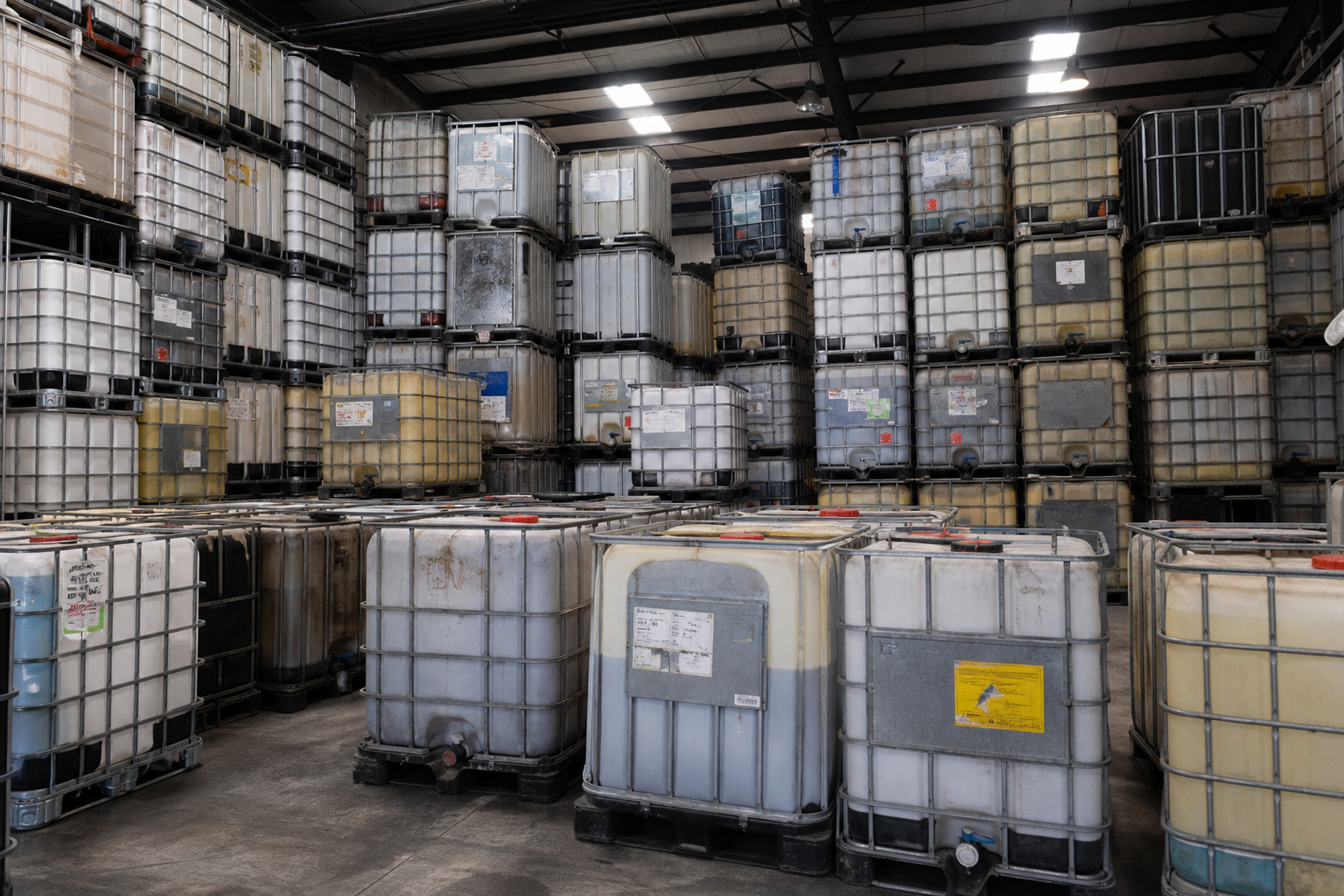
Inside the operation
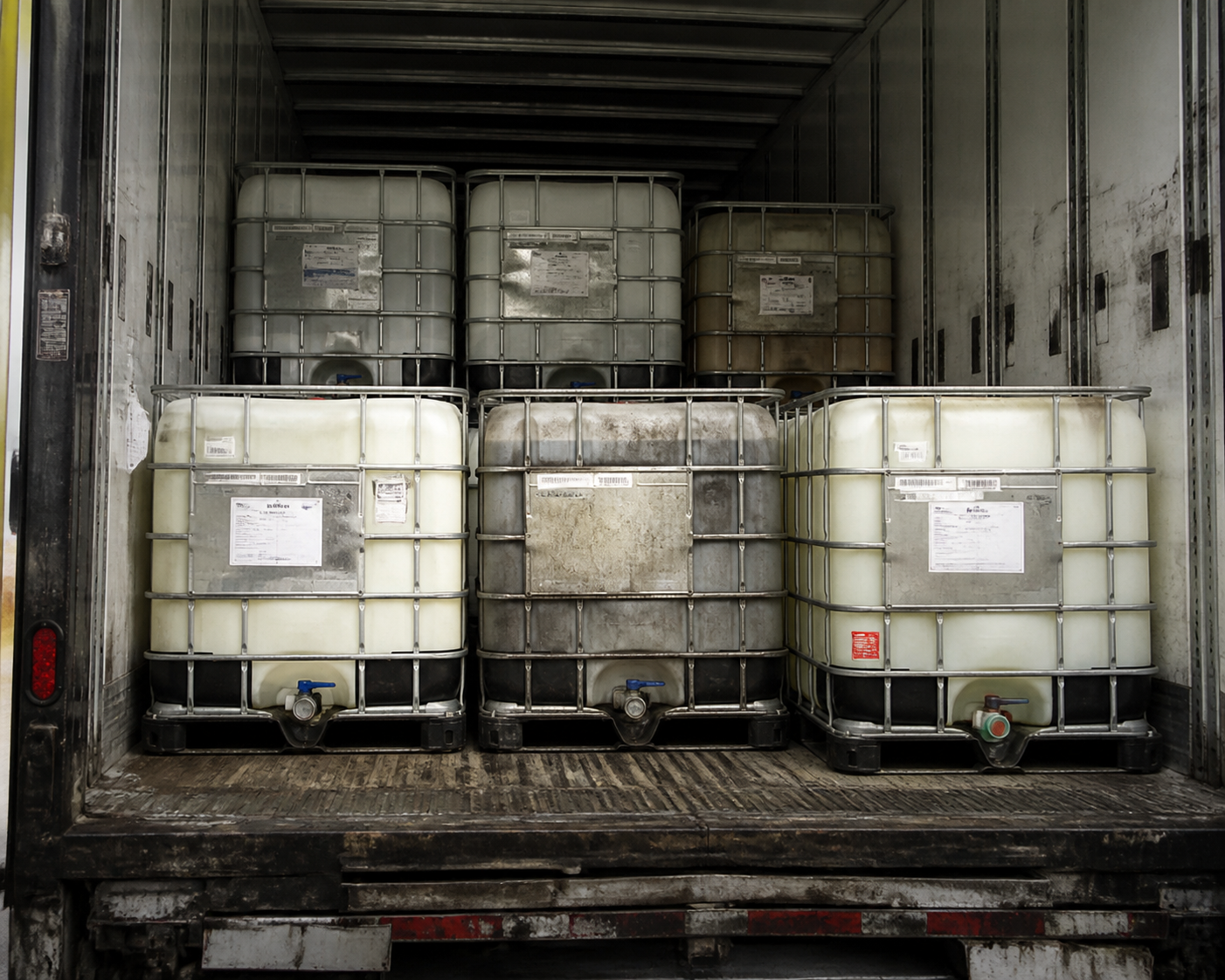
Real yard, real totes, real reuse.
Why it matters
Every reused tote is a small act of climate math.
The Impact Engine
See your footprint shrink in real time.
Our little party trick: dial in how many totes you'd reuse instead of buying new, and watch the environmental savings add up. This is the whole business case in one slider.
Estimates based on the HDPE + galvanized-steel footprint of a caged IBC. Reuse keeps the whole assembly working instead of manufacturing it twice.
What we do
Five services, one circular loop.
The 5 R's
A tote's life doesn't end. It loops.
Recover
We collect empty totes from customers nationwide before they hit a dumpster.
Recondition
Triple-rinse washing, cage repair, and rebottling return them to service.
Redeploy
Cleaned, graded, and documented totes ship back out to new customers.
Repurpose
Totes past liquid duty become rain harvesters, planters, and dock floats.
Recycle
Only at true end-of-life — HDPE and steel recovered, zero to landfill.
↻ and around again — most totes run this loop many times
Industries we serve
If it moves liquid in bulk, we probably supply it.
Totes are the workhorse of American industry. Here is how the sectors we ship to most actually put reconditioned IBCs to work — and what we match to each one.
Farms & growers
Bulk water, liquid fertilizer, and non-potable irrigation storage. Growers love reconditioned Grade A totes because they cost a fraction of new and hold up for seasons.
- Nurse tanks & field water
- Liquid fertilizer & bloom nutrients
- Rain catchment on a slab or pallet
Processors & co-packers
Food-grade totes for juice concentrate, oils, sweeteners, brine, and vinegar. We supply totes with documented previous contents and rebottled options for the most sensitive fills.
- Never-held-hazmat food-grade
- Rebottled with a virgin HDPE bottle
- Traceable previous-contents records
Blenders & distributors
Cleaners, surfactants, acids, and industrial fluids. We match cage rating, gasket material, and valve type to your chemistry so nothing degrades the bottle or fittings.
- Chemical-compatible gaskets
- 2 in. & 3 in. valve options
- UN-marked totes on request
Fleet & fuel operations
Diesel Exhaust Fluid (DEF), lubricants, glycol, and hydraulic oil. DEF demands scrupulously clean, dedicated totes — we supply totes reserved for DEF service only.
- DEF-dedicated, contamination-free
- Lube & hydraulic oil storage
- Glycol & coolant handling
Cultivators & extractors
Nutrient dosing, reverse-osmosis water, and runoff capture for indoor and greenhouse grows. Compact 275-gallon totes tuck neatly into tight cultivation footprints.
- RO water & nutrient reservoirs
- Runoff & wastewater capture
- Space-saving 275 footprint
Beer, wine & cider
Grain water, cleaning chemistry (caustic & acid CIP), and spent-liquid handling. Food-grade totes keep sanitary processes sanitary; standard totes handle the messy jobs.
- CIP caustic & acid storage
- Brewing & rinse water
- Spent grain slurry transfer
Municipal & industrial
Coagulants, polymer, chlorine solutions, and sludge dewatering aids. Rugged reconditioned totes stand up to plant chemistry at a fraction of new-tote cost.
- Polymer & coagulant dosing
- Sodium hypochlorite storage
- Portable batch mixing
Sites & contractors
Jobsite water, dust suppression, concrete admixtures, and washout containment. Totes ride forklifts and pallet jacks anywhere on site and stack when empty.
- Potable & non-potable water
- Dust control & wheel wash
- Admixture & release-agent storage
Not on the list? We routinely supply totes for soap and detergent blending, printing inks, adhesives, de-icing fluid, honey, maple syrup, and dozens of other fills. Email us your product and we'll tell you exactly which grade and valve fit.
How it works
Buying and selling totes, start to finish.
No account to create, no salesperson to dodge. Everything happens by email and written quote so you always have the specs and price in hand.
Buying reconditioned totes
Tell us what you need
Email us or use the quote form: gallons, grade, previous contents you can accept, and your ZIP for freight.
We match & quote in writing
You get a written quote with the exact grade, valve type, and lead time — no phone tag, no pressure.
Inspection & prep
Totes are washed, pressure-checked, cage-inspected, and photographed before they leave Berea.
Freight & delivery
We arrange LTL or full-truckload shipping to all 48 contiguous states, palletized and strapped.
Selling your empty totes
Send a photo & count
Snap the cage label and a wide shot, tell us the previous contents and how many you have.
Get an offer
We reply with a written buyback offer based on grade, condition, quantity, and your location.
We handle pickup
For qualifying volumes we coordinate freight and reverse logistics — you just palletize.
You get paid & a report
You receive payment plus a diversion figure you can drop straight into your ESG reporting.
Reconditioned vs. new
When does reused win? Almost always.
New totes have their place for spec-locked, first-use regulated fills. For nearly everything else, a reconditioned tote does the same job for a lot less carbon and cash.
| Factor | Reconditioned | New |
|---|---|---|
| Typical cost vs. new | 40–65% less | Full list price |
| Carbon footprint | ~122 kg CO2e avoided per tote | New steel + virgin HDPE emissions |
| Lead time | Usually in stock, ships fast | Often build-to-order |
| Bottle | Cleaned original or rebottled HDPE | Virgin HDPE |
| Cage & pallet | Inspected, repaired, load-tested | New galvanized steel |
| Best for | Most water, ag, and industrial fills | Regulated first-use / spec-locked fills |
Rule of thumb: if your liquid is water-based, agricultural, or a common industrial chemical, reconditioned is the smart call. If you need a UN-marked tote for regulated transport of a specific product, ask us — we stock those too.
275 vs. 330 gallon
Same footprint, different height and volume.
| Spec | 275 gallon | 330 gallon |
|---|---|---|
| Volume | 275 gal / 1,040 L | 330 gal / 1,250 L |
| Footprint | 40 x 48 in (standard pallet) | 40 x 48 in (standard pallet) |
| Height | About 46 in | About 53 in |
| Empty weight | About 125–135 lb | About 145–160 lb |
| Best when | Height-limited racks & vans | Max volume per pallet position |
Inventory
Totes for every liquid, grade, and budget.
Caged Composite IBC
The workhorse. An HDPE inner bottle cradled in a galvanized-steel cage on a pallet base. The format 90% of the industry runs on — and the one we recondition by the thousand.
Product details →Food-Grade IBC
Totes whose only prior life held food-safe contents, then triple-rinsed and documented. FDA-compliant virgin HDPE, traceable prior-product history.
Product details →Rebottled IBC
A brand-new HDPE bottle dropped into a reconditioned cage and pallet. The sweet spot between fully new and fully used — pristine interior, circular frame.
Product details →Insulated & Heated IBC
Totes wrapped with insulating jackets or fitted with band/immersion heaters to keep waxes, resins, and food products flowing through cold months.
Product details →Stainless Steel IBC
304/316 stainless bins for aggressive chemistries, high-purity processes, and closed-loop programs where a tote runs hundreds of cycles instead of a handful.
Product details →UN/DOT Hazmat IBC
Totes carrying valid UN31HA1 / 31HA2 rating plates for shipping regulated goods, with documented pressure-test dates and compliant fittings.
Product details →Quality you can document
Every tote is inspected, not just wiped down.
Triple-rinse washing
Bottles are washed and, where needed, hot-rinsed to remove residue. Food-grade and rebottled options meet stricter cleanliness for sensitive fills.
Cage & pallet inspection
Every cage is checked for cracks, corrosion, and weld integrity. Bent bars are repaired and the steel base is load-tested before a tote ships.
Pressure & leak check
Bottles are pressure-checked and valves and gaskets are verified so you don't discover a weep after you fill 275 gallons.
Previous-contents records
We track what a tote last held so you can confirm compatibility with your chemistry before it ever arrives.
UN-marked on request
Need to transport a regulated liquid? We source totes with valid UN markings for hazmat service — just tell us the product.
Diversion figures
Buy or sell and we can supply the landfill-diversion and CO2-avoided numbers your ESG and sustainability teams need.
Our whole reason for being
Sustainability isn't our marketing. It's our supply chain.
A new IBC tote is roughly 26 lb of virgin plastic bolted into 90 lb of new steel. Building one from scratch when a perfectly good tote is sitting on someone's dock is a waste of carbon, water, and money. Our entire model exists to close that gap.
“The greenest tote is the one that already exists.”
Coverage & logistics
Shipping totes coast to coast from Ohio.
We're based at 931 W Bagley Rd, Berea, OH 44017 — a central location that keeps freight to most of the country short and affordable. Totes ship palletized and strapped by LTL for small orders or full truckload for larger runs.
- All 48 contiguous states served
- LTL for a handful of totes, FTL for pallets of them
- Reverse logistics for buyback pickups on qualifying volumes
- Freight quoted in writing alongside your totes — no surprises
Central Ohio → most of the USA in one or two freight days.
Talk the talk
A quick IBC glossary before you order.
A little vocabulary makes for a much tighter quote. Here are the terms you'll see on our site and in your written offer.
IBC
Intermediate Bulk Container — a reusable industrial tank sized between drums and a bulk tanker, typically 275 or 330 gallons.
Bottle
The HDPE (high-density polyethylene) inner vessel that actually holds the liquid.
Cage
The welded galvanized-steel frame that protects the bottle and lets a forklift move it.
Rebottled
A tote fitted with a brand-new HDPE bottle inside a reconditioned cage and pallet — near-new cleanliness at a lower cost.
Grade A
A reconditioned tote that is structurally sound, cleaned, and pressure-checked for general industrial reuse.
Food-grade
A tote that has only ever held food-safe products and is cleaned to food-contact standards.
UN mark
Certification stamped on the cage indicating the tote is rated to transport regulated (hazmat) liquids.
Butterfly valve
The disc-style discharge valve at the base; common sizes are 2 in. and 3 in. with camlock or buttress threads.
Knowledge Hub
Straight answers on totes, grades & sizes.
IBC Tote Dimensions Explained: Every Size, Spec & Footprint
The complete reference on IBC tote sizes — 275 vs 330 gallon, footprints, heights, weights, and how to plan your floor space and freight.
Read the guide →6 MIN READFood-Grade IBC Totes: What Qualifies and How to Verify
What actually makes an IBC tote food-grade, how reconditioners verify it, and the questions to ask before you fill one with anything edible.
Read the guide →8 MIN READ27 Clever Ways to Repurpose an IBC Tote
From rainwater harvesting to aquaponics and dock floats — the most useful second lives for a retired IBC tote, and which grade you need for each.
Read the guide →IBC totes at a glance
The fast facts, before you dig in.
New to intermediate bulk containers? Here's the practical shortlist we wish every buyer had on day one — the numbers, the checks, and the trade-offs that actually matter.
275 & 330 gal
The two standard sizes — 1,040 L and 1,250 L — both on the same 40 × 48 in pallet footprint.
HDPE + steel
A blow-molded HDPE bottle cradled in a galvanized steel cage on a composite, steel, or wood pallet.
2" NPT valve
A bottom butterfly or ball valve, adaptable to camlock, garden-hose, or hard pipe with a fitting.
≈ 125–150 lb
Light enough for one pallet position; a water-filled 275 approaches 2,400 lb, so mind rack ratings.
A 6-point checklist before you buy used
- Prior contents. Ask what the tote last held — and whether that history is documented.
- Grade. Match Grade A, food-grade, or rebottled to your actual liquid, not just price.
- Bottle. Look for clarity, no stress-cracking, and no lingering odor inside.
- Cage & pallet. Straight bars, sound welds, and an intact base rated to stack.
- Fittings. A valve that seals, the right gasket (EPDM vs Viton), and a good cap.
- Compliance. For regulated liquids, confirm a valid UN mark and current retest date.
Every tote we ship is drained, washed to grade, inspected against this list, and photographed — so you approve the exact unit before it leaves Berea.
FAQ
Questions people ask before their first order.
How much can I really save buying reconditioned totes?
Most customers pay 40 to 65 percent less than the price of a comparable new tote. The exact number depends on grade, quantity, valve type, and your freight distance from Berea, Ohio. Higher volumes and standard configurations land at the low end of the price range.
Do you have a phone number I can call?
We work by email and web form on purpose — it keeps a written record of your specs, quote, and lead time so nothing gets lost in translation. Email info@ibctotessolutions.com or use the quote form and you will get a fast, written reply.
How fast can totes ship after I place an order?
Standard reconditioned 275 and 330 gallon totes are usually in stock and can ship within a few business days once your written quote is approved. Rebottled and food-grade configurations may add a short lead time depending on volume.
Which states do you deliver to?
We ship to all 48 contiguous states from our Berea, Ohio facility via LTL and full-truckload freight. Totes leave palletized and strapped. Tell us your ZIP code and we will quote freight along with the totes.
What is the difference between a 275 and a 330 gallon tote?
Both sit on the same 40 by 48 inch pallet footprint. The 275 is roughly 46 inches tall; the 330 is roughly 53 inches tall and holds about 55 more gallons. Choose the 275 when height or rack clearance is tight, and the 330 when you want maximum volume per pallet position.
Can you buy the empty totes we already have on site?
Yes. Send a photo of the cage label and tell us the previous contents and quantity, and we will send a written buyback offer. For qualifying volumes we coordinate the freight and reverse logistics, and you receive a landfill-diversion figure for your ESG reporting.
Are your totes safe for food or drinking water?
For food and potable applications we supply food-grade totes that have only ever held food-safe products, or rebottled totes with a brand-new HDPE bottle. Always confirm your specific use with us so we match the right grade and gasket material.
Let's close the loop
Ready to buy, sell, or recycle totes?
No phone tag — we work by email and web form, and we reply fast, in writing.