Repurposed Goods
A tote's best second life, built for you.
Repurposing beats recycling — it keeps the whole assembly working for another decade instead of grinding it down. Here's what a retired tote becomes in our shop.
Quick answer: We turn retired IBC totes into finished rainwater harvesters, raised planters, aquaponics systems, dock floats, spill berms, and compost brewers. Anything touching potable water or edibles uses food-grade totes.
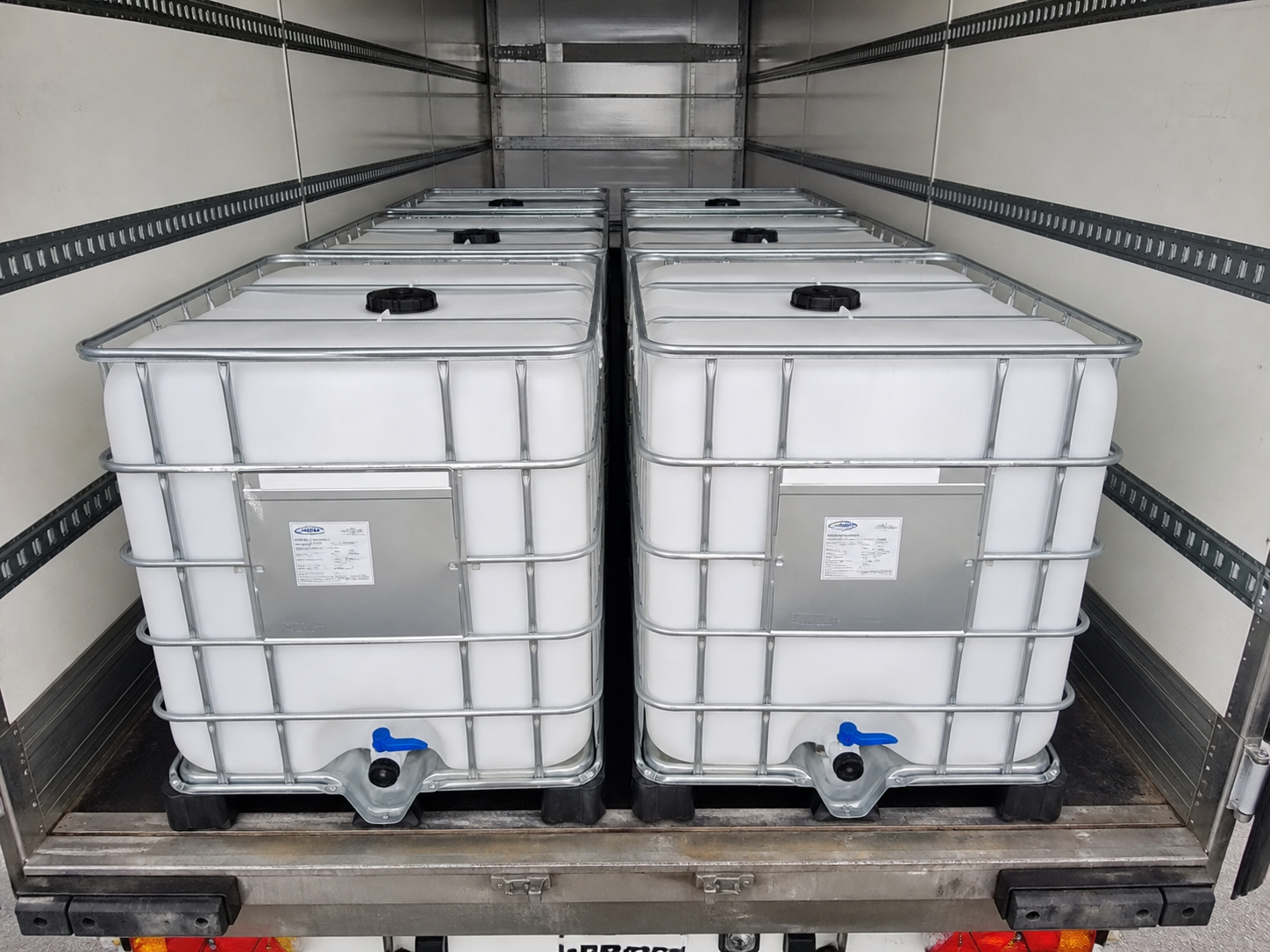
Rainwater Harvesters
Single- or multi-tote cisterns plumbed with valves, overflow, and filtration — ready to catch a roof's worth of runoff.
- Recommended: Food-grade for potable
Raised Planters
Totes cut and framed into deep raised beds and vertical growing walls, built to drain and last outdoors.
- Recommended: Any grade
Aquaponics Systems
Fish-tank-and-grow-bed builds using the tote's food-safe HDPE — a closed loop of its own.
- Recommended: Food-grade
Dock Floats & Pontoons
Sealed, buoyant bottles caged and mounted into floating docks, swim platforms, and work rafts.
- Recommended: Any grade
Spill-Containment Berms
Portable secondary containment and ballast structures for job sites and yards.
- Recommended: Any grade
Compost Tea Brewers
Aerated liquid-feed and compost-tea tanks for market gardens and farms.
- Recommended: Food-grade
Why it's the greenest option
Repurposing skips the grinder entirely.
Recycling a tote still burns energy to shred and re-pelletize it. Repurposing keeps the HDPE bottle and steel cage intact and useful — often for another ten years. It's reuse at its most complete, and it's where a tote's carbon investment pays off most.
Cut once, use for a decade. That's the greenest math in the yard.
The full project catalog
Nine more second lives, with the grade that fits.
Beyond the headline builds, a retired tote solves a surprising number of everyday problems — from watering pasture to weighting a tent. Each project has a grade that matters and one that doesn't; we've flagged both so you order right the first time.
Livestock & Pasture Water
Gravity-fed stock tanks and paddock troughs. Position a tote uphill, run a float valve, and water rotational grazing without hauling buckets.
- Grade: Grade A minimum; food-grade if the same water feeds a garden.
Emergency Water Reserve
A stored 275- or 330-gallon buffer for outages, wildfire zones, and off-grid cabins. Kept full, rotated, and shaded, one tote covers weeks of household non-potable needs.
- Grade: Food-grade, opaque or shrouded to block light.
Drip-Irrigation Header Tanks
Elevated totes feed low-pressure drip lines across a market plot. The 46-inch footprint drops straight onto a pallet-rack stand.
- Grade: Any grade for ornamentals; food-grade for edibles.
Vertical & Wicking Beds
Bottles sliced lengthwise become self-watering wicking planters or tiered wall gardens with a built-in reservoir below the root zone.
- Grade: Food-grade for anything you eat.
Ballast & Barrier Weights
Filled with water or sand, caged totes anchor tents, sign frames, fall-protection cantilevers, and temporary fencing on hardscape.
- Grade: Any grade; cosmetic condition is irrelevant.
Wash & Rinse Stations
A gravity tote plus a valve makes a boot-wash, tool-rinse, or field hand-wash station where no tap exists.
- Grade: Grade A; food-grade if potable rinse is required.
Swim & Work Rafts
Four sealed bottles under a treated deck float roughly two thousand pounds. The steel cage doubles as the sub-frame.
- Grade: Any grade; verify every bottle holds air.
Liquid Feed & Molasses Tanks
Warm-room storage and dispensing for livestock supplements, foliar feeds, and fish emulsion, valved for clean draw-off.
- Grade: Food-grade for anything ingested by animals.
Greywater & Roof-Runoff Buffers
Non-potable capture for flushing, laundry pre-fill, and slow-release landscape watering during dry spells.
- Grade: Any grade; label clearly as non-potable.
Build considerations
What separates a project that lasts from one that leaks.
A tote is a great starting point, not a finished product. Every build we ship runs through the same five checks — the same ones that trip up a weekend DIY project when they get skipped.
Confirm the contents history
Before any potable, edible, or livestock project, we pull the prior-contents record. A tote that held food-safe cargo and was triple-rinsed is a different animal from one that carried a surfactant.
Pressure- and leak-test the bottle
Dock floats and cisterns live or die on a sealed bottle. Every buoyancy build gets each bottle water-tested and every cistern gets a fill-and-hold check before it ships.
Plan drainage and overflow
Planters need holes low and drain paths clear; cisterns need an overflow routed away from foundations. We size overflow to match your roof's peak flow, not just the inlet.
Shroud against UV and algae
Bare HDPE chalks and clouds in sun, and any light reaching stored water grows algae. We wrap, paint, or box exposed totes to push service life past a decade.
Add the right fittings
Cam-lock, garden-hose, or NPT bulkhead — the fittings decide how the tote connects to the rest of your system. We standardize on serviceable, replaceable hardware.
Food safety, straight
When the tote touches water you drink or food you grow.
The HDPE is food-safe from the factory. The variable is history and cleaning. Here is exactly how we keep a repurposed tote honest for potable and edible use.
Start with FDA-compliant HDPE
Every reconditionable IBC bottle is molded from food-contact HDPE, so the resin itself is safe. The question is never the plastic — it is what the plastic last held.
Only ever food-safe cargo
For potable and edible builds we source totes that carried food-grade contents exclusively: syrups, juices, edible oils, vinegar, food additives. No exceptions and no unknowns.
Documented cleaning
Food-grade repurposing gets a rinse-and-inspection record. You get paper, not a promise, so a health inspector or a nervous neighbor has an answer.
Light control equals water quality
Even a food-grade cistern grows algae if sunlight reaches the water. Opaque totes or a full shroud keep stored water clear and drinkable far longer.
One rule underneath all of it: if a build will hold potable water or grow food, start food-grade. Downgrading later is impossible; over-specifying is cheap insurance.
Longevity & UV
Why our builds outlast a bare tote in the yard.
The difference between a five-year project and a fifteen-year one is almost never the tote — it is what you do to protect it. Here is where a raw DIY build fails and where a finished build is engineered to hold.
| Failure point | Raw / unprotected tote | Our finished build |
|---|---|---|
| UV exposure | Bare white bottle chalks and hazes within a few seasons of direct sun. | Shrouded, painted, or boxed — HDPE protected, expected life a decade-plus. |
| Freeze cycles | Water left in over winter can split a bottle or crack a valve. | Drain-downs, insulated jackets, and freeze-tolerant plumbing built in. |
| Cage corrosion | Galvanized cage surface-rusts where coating is scratched. | Touched-up or powder-recoated at cut and weld points. |
| Valve wear | Original valve gasket dries and weeps after years of sun. | New serviceable valve and hardware you can rebuild, not replace. |
Custom fabrication
Bring a drawing. We'll build it.
Cut lines, plumbing runs, fittings, stands, shrouds, manifolds tying several totes together — if it starts with an IBC, we can fabricate it. Send dimensions and what the build needs to do, and we'll scope grade, materials, and the right hardware for the job.
DIY or pre-made? Pre-made if it holds water, floats, or feeds a garden — that's where the details matter.
Questions we get
Repurposed tote FAQ.
Can I drink rainwater collected in a repurposed tote?
Only from a food-grade tote that carried food-safe contents, was cleaned and documented, and is shrouded against light — and only after appropriate filtration and disinfection for the roof it collects from. We build the vessel; final potability depends on your first-flush diverter, filtration, and local rules. When in doubt, treat harvested water as non-potable.
What grade do I need for a vegetable planter?
For anything you will eat, use a food-grade tote. The HDPE is food-safe to begin with, but you want a documented food-safe contents history so nothing leaches into the root zone. For flowers and ornamentals, any grade works fine.
How much weight will an IBC-tote dock float support?
A single sealed 275-gallon bottle displaces roughly 2,200 pounds of water at full submersion, but you design for a fraction of that so the deck rides high and stable. Four bottles comfortably float a two-thousand-pound platform with freeboard to spare. We test every bottle for a seal before it goes near water.
Do you build custom, or only stock designs?
Both. We keep common configurations ready and we fabricate to a drawing or a sketch — cut lines, plumbing, fittings, stands, and shrouds to your spec. Email info@ibctotessolutions.com with dimensions and what it needs to do, and we will scope it.
Why repurpose instead of just buying a new rain barrel?
A repurposed tote reuses an entire HDPE-and-steel assembly that already exists, skipping the grinder and the new-plastic supply chain entirely. You get five to ten times the capacity of a hardware-store barrel, and it is the greenest math in the yard: cut once, use for a decade.