Why Reused Wins
Reused totes give up nothing — except the waste.
The myth is that 'used' means 'lesser.' For IBC totes, a properly reconditioned unit matches new on every spec that matters and beats it on cost and carbon. Here's the evidence.
Quick answer: Reconditioned IBC totes share the exact mold, cage, and fittings as new ones, cost 40–65% less, and avoid ~122 kg CO₂e each — making reuse the better choice on spec, price, and planet.
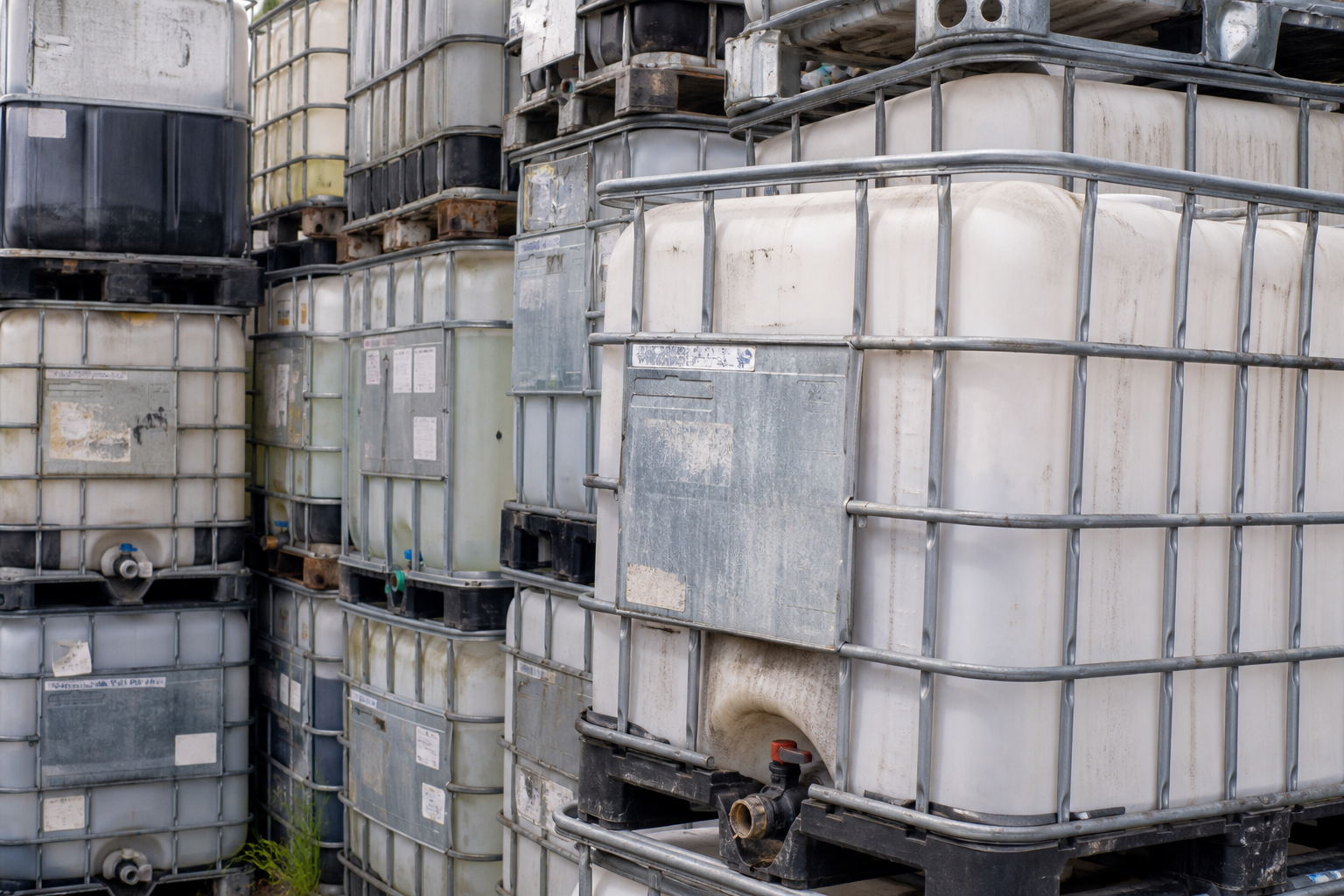
Six reasons
The circular tote out-competes the new one.
Identical spec
A reconditioned 275 or 330 tote uses the same mold, cage, pallet, and fittings as new. Same footprint, same stackability, same performance.
40–65% lower cost
You're paying for cleaning and inspection, not for manufacturing 116 lb of new plastic and steel. The savings scale with volume.
A fraction of the carbon
Skipping resin production, steel forming, and cage assembly avoids roughly 122 kg CO₂e per tote — before you count freight savings.
Available now
Reconditioned inventory sits ready in Berea. No long lead times waiting on a new production run.
Documented history
Every tote comes with grade and prior-contents documentation — often more transparency than a generic new tote offers.
Closes your loop
Buy reconditioned and sell your empties back, and your packaging becomes a loop instead of a line item that ends in a dumpster.
Cost, line by line
Where the money actually goes.
The headline is a 40–65% lower unit price, but the full picture is wider. Here is how new and reconditioned compare across the costs that hit your budget over a tote's life.
| Cost line | New tote | Reconditioned | Why it matters |
|---|---|---|---|
| Unit price (typical 275-gal) | $180–$260 | $75–$135 | The single biggest gap — you skip paying to manufacture new plastic and steel. |
| Lead time | Days to weeks | In stock | Reconditioned inventory ships from Berea without a production queue. |
| Freight per unit | Same | Same or lower | Consolidated reused truckloads often move on efficient regional lanes. |
| Empty-tote buyback | None | Available | Sell your empties back and offset the next purchase — a true loop. |
| Disposal cost at end | Yours to pay | We recover it | Recovery replaces a dumpster fee with a recovery credit. |
| Embodied carbon | Full footprint | ~122 kg CO₂e avoided | You inherit a tote whose production footprint was already paid once. |
The environmental math
Carbon, water, and plastic — per tote, per fleet.
Every reconditioned tote you buy is a new tote never manufactured. That single decision avoids the full production footprint of an IBC — the part of a tote's life that carries most of its impact.
- ~122 kg CO₂e avoided per tote by skipping resin production, steel forming, and cage assembly.
- ~980 L of water saved per tote versus the water intensity of virgin HDPE and steel manufacture.
- ~12 kg of virgin plastic avoided per tote — HDPE that never has to be extracted, refined, and molded.
- ~118 kg diverted from landfill per tote by keeping the unit in service instead of burying it.
Multiply any of those by a fleet of hundreds or thousands of totes and the figures become tonnes of avoided emissions and cubic meters of saved water — numbers real enough to put in a report.
Most of a tote's footprint is spent the day it is made. Reuse means you never spend it again.
Myth vs fact
Clearing up the “used” objections.
| The myth | The fact |
|---|---|
| Used means worn out. | A caged IBC is engineered for a decade-plus of service. A reconditioned unit is usually early in that life, inspected and graded before it ships. |
| Reused totes leak or fail. | Every unit is pressure-checked, gets new or verified valves and gaskets, and carries a grade sheet. Failures come from skipped inspection, which we do not skip. |
| You can't trace the history. | We document prior contents and grade for each tote — often more transparency than a generic new unit that arrives with no paperwork at all. |
| It won't work for sensitive fills. | That is exactly what rebottled totes solve: a brand-new HDPE bottle in a reconditioned cage. New-interior purity, circular frame. |
| Savings disappear on freight. | Freight is roughly the same per unit regardless of whether the tote is new or reused. The unit-price gap survives shipping intact. |
| Reused is only about being green. | The carbon win is real, but the cost win lands first. Most buyers switch to save 40–65% and discover the sustainability benefit as a bonus. |
Spec parity
Reconditioned matches new where it counts.
Same mold, same cage, same footprint. Here is the side-by-side that QA teams ask for.
| Spec | Reconditioned tote |
|---|---|
| Bottle material | Same food-grade HDPE, same mold |
| Capacity | 275 or 330 US gallons, identical to new |
| Footprint | 40 x 48 in pallet base — standard, stackable |
| Cage | Galvanized steel, weld-repaired and stack-rated |
| Fittings | New or verified valves, gaskets, and lids |
| Stackability | Restored to spec; same warehouse and transport handling |
By industry
Where reused totes fit best.
Chemical blending
A blender running dozens of non-hazard formulations swaps to reconditioned totes for bulk intermediates, cutting packaging spend 50%+ and selling empties back after each campaign.
Agriculture & liquid feed
Seasonal fill needs make in-stock reconditioned totes ideal — no waiting on a production run when the season hits, and repurposed units handle water and feed storage on-farm.
Food & beverage (rebottled)
Where a virgin interior is non-negotiable, rebottled totes deliver new-bottle purity on a circular cage — the sustainability story without compromising the fill.
Industrial cleaners & soaps
High-volume, cost-sensitive fills are the sweet spot for reconditioned units. Buyback and reuse turn packaging from a sunk cost into a managed loop.
Objections, answered
The pushback we hear — and the reply.
My QA team won't approve used packaging.
Share our grade sheet and prior-contents documentation, and for anything requiring a virgin interior specify rebottled units. QA teams approve reconditioned totes every day once the inspection record is on the table.
We need consistent supply, not one-off lots.
Reconditioning at volume is exactly what we built. We supply standing programs, not just spot lots, and can hold grade and quantity across recurring orders.
What if a tote arrives with a problem?
Email us. Because everything is documented and graded, resolving an issue is fast and written down — no phone tag, no lost paper trail.
Is the price really that much lower?
Yes. You are paying for cleaning, inspection, and repair rather than the manufacture of 116 lb of new plastic and steel. The 40–65% gap is structural, not a promotion.
Run the numbers
Put your own volume through the Impact Engine.
Estimates based on the HDPE + galvanized-steel footprint of a caged IBC. Reuse keeps the whole assembly working instead of manufacturing it twice.
The one exception
When new (or rebottled) actually makes sense.
Some applications demand a virgin interior — think sensitive beverages or pharma. That's exactly what rebottled totes are for: a brand-new HDPE bottle in a reconditioned cage. New-bottle purity, circular frame, lower footprint.
Frequently asked
Everything else about buying reused.
Do reused IBC totes meet the same specs as new?
On the specs that matter — capacity, footprint, HDPE bottle, galvanized cage, stackability, and fittings — a properly reconditioned tote matches new. It uses the same mold and cage; it has simply been cleaned, inspected, and repaired rather than freshly manufactured.
How much can I actually save?
Typically 40–65% versus new on a per-unit basis, and more once you factor in empty-tote buyback and avoided disposal costs. Run your own volume through the Impact Engine above for a tailored figure.
How much carbon does buying reused avoid?
Roughly 122 kg CO₂e per tote by skipping resin production, steel forming, and cage assembly — before freight savings. Across a fleet that adds up to tonnes of avoided emissions you can report.
When should I choose rebottled instead of reconditioned?
Choose rebottled when the application needs a virgin HDPE interior — sensitive beverages, certain food, or pharma-adjacent fills. You get a brand-new bottle in a reconditioned cage: new-interior purity with a circular frame and lower footprint than fully new.
Can I sell my empties back to close the loop?
Yes. Buying reconditioned and selling empties back turns your packaging into a loop rather than a one-way expense that ends in a dumpster. Email us your quantities and location.
Is reused inventory really in stock?
Yes — reconditioned totes sit ready in Berea, Ohio, so you skip the lead time of a new production run. Availability by size and grade is confirmed in writing when you email for a quote.