Why purchase price is the wrong number to compare
Procurement decisions often fixate on the unit price of a container, but that number hides most of the real cost. Total cost of ownership counts everything a container consumes over its working life: acquisition, filling and handling labor, freight, storage, cleaning or disposal, and any recovered value at end of life. Compared on that basis, packaging choices that look similar on a price sheet can differ enormously in true cost.
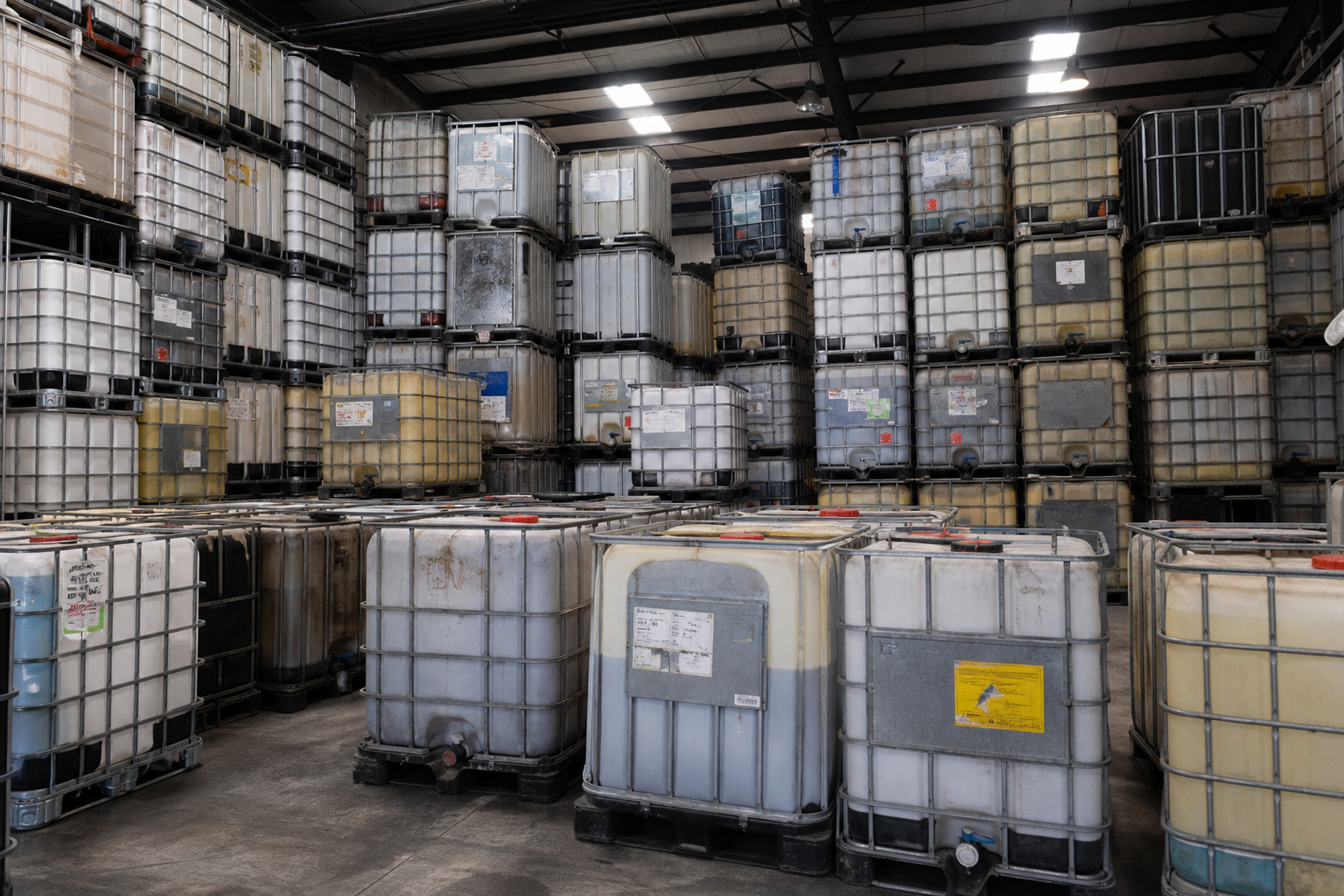
The comparison that matters for most bulk liquid shippers is reusable IBC totes against one way packaging, whether that is single use drums, pails, or disposable containers. The following sections walk through each cost driver so you can build the comparison for your own operation.
The power of amortizing over many cycles
A reusable tote's defining advantage is that its cost spreads across many trips. A one way container is bought, used once, and discarded, so its full price lands on a single shipment. A tote that cycles dozens of times divides its cost across all of those uses, so the effective cost per fill drops with each cycle.
Consider the drum equivalence. One tote replaces roughly five 55 gallon drums per fill. If that tote makes many round trips over its life, the number of drums it displaces climbs into the hundreds. Even before counting any other factor, spreading one durable asset across that many uses undercuts the repeated purchase of single use containers.
Freight and handling efficiency
Freight is often the largest hidden cost, and totes win here too. A palletized tote is a single forklift move, while the equivalent volume in drums is five separate units to load, brace, and unload, multiplying labor and handling time. Totes also cube out a trailer more efficiently and stack safely, so you move more product per truck.
Handling labor compounds over a year. Every extra container is another item to move, connect, dispense, and clear.
- One tote versus five drums means one lift instead of five per equivalent volume.
- Palletized totes load and unload faster, reducing dock time and demurrage.
- Stackable totes use trailer height, improving payload per shipment.
- Fewer connect and disconnect cycles at dispensing means less labor and less spill risk.
Disposal costs that one-way packaging quietly adds
One way packaging does not end at use; it ends at disposal, and disposal is rarely free. Empty drums and contaminated single use containers often must be handled as regulated waste, triggering disposal fees, hauling charges, and administrative burden. Those costs recur on every shipment and are easy to overlook when comparing purchase prices.
A reusable tote program largely erases this line. Instead of paying to dispose of packaging, the container is cleaned and sent back into service, or returned to a supplier. Removing a recurring disposal fee from every shipment is a direct and permanent saving, and it is also a large reduction in the waste stream your operation generates.
Buyback and residual value
One way packaging has no exit value; you pay to remove it. Reusable totes retain resale worth, which flips the end of life from a cost into a recovery. When you no longer need a fleet of totes, or you accumulate surplus units, those totes can be sold back into the reuse market rather than scrapped.
Buyback matters at both ends of the program. It lowers the effective net cost of the totes you buy, because you can expect to recover value later, and it turns idle surplus into cash instead of a storage and disposal problem. Factoring residual value into the total cost calculation often tips a borderline comparison decisively toward reuse.
Building your own total cost comparison
To compare fairly for your operation, tally the full picture for each option rather than the price alone. For one way packaging, add purchase price, handling labor, freight, and disposal, and multiply by the number of shipments over the period. For a reusable tote program, add acquisition or reconditioning cost, divide by expected cycles, then add per cycle cleaning, freight, and handling, and subtract expected buyback value.
Run the numbers over a realistic horizon such as a year or the full asset life. In the large majority of bulk liquid scenarios, the reusable program produces a lower cost per gallon shipped once cycles, freight, and disposal are all in the model. The exceptions tend to be very low volume or one time shipments where cycling never begins.
Cost and sustainability point the same direction
One of the satisfying features of this analysis is that the cheapest answer is usually the greenest one. Every reuse cycle avoids manufacturing a new container and avoids disposing of an old one, cutting raw material use, energy, and landfill volume. The financial case and the environmental case are not in tension; they reinforce each other.
That alignment is why reuse first packaging strategies have moved from sustainability initiatives into core procurement. Lowering cost per shipment and lowering waste per shipment turn out to be the same project.
Setting up a reusable program
If you want to model a reusable tote program or start buying reconditioned totes and selling back surplus, we can help you build the numbers and the supply. IBC Tote Solutions buys, sells, reconditions, and transports totes from Berea, Ohio, including buyback of units you no longer need.
Share your volumes, shipment frequency, and current packaging through our quote form or at info@ibctotessolutions.com, and we will help you compare total cost of ownership honestly.