Two very different containers
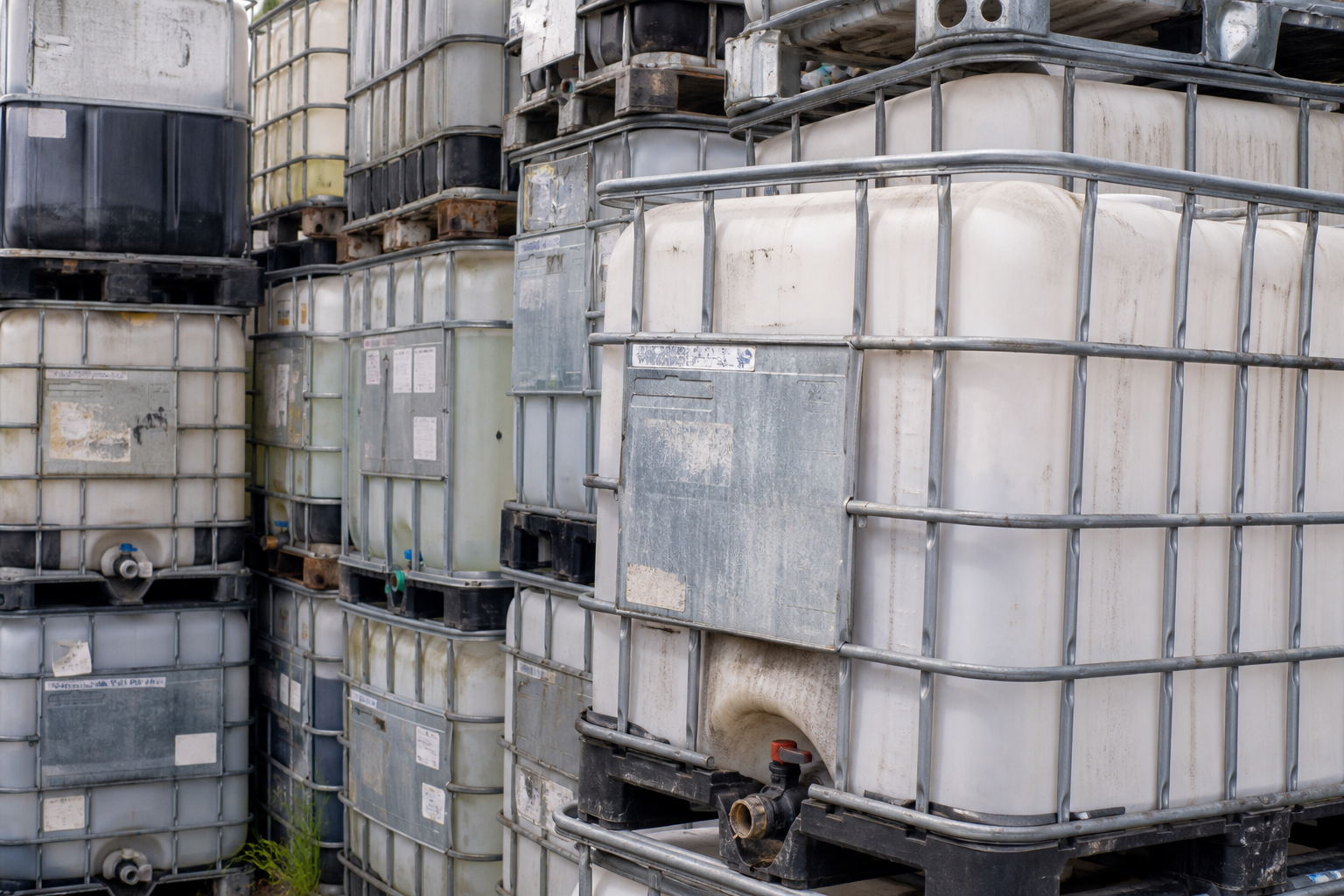
A 55-gallon drum is a single upright barrel, usually steel or HDPE, that holds 55 gallons. An IBC tote is a 275 or 330 gallon HDPE bottle in a galvanized steel cage on an integrated pallet base. One IBC replaces roughly five to six drums, which reframes almost every comparison between them.
Neither is simply better than the other. The right choice depends on how much liquid you move, how you move it, how much floor space you have, and how your product is dispensed and consumed. Matching the container to the job is what saves money and effort.
Capacity and cost per gallon
On a per-gallon basis, totes are hard to beat. Consolidating five or six drums into a single 275 or 330 gallon tote means one container to buy, one to fill, one to clean and one to move instead of six of everything. That consolidation lowers the effective cost per gallon of storage and handling substantially.
It also compounds over a fleet. Fewer containers means fewer connections to leak, fewer units to track, and less labor spent moving and cleaning. When you are handling real volume, the tote's efficiency advantage grows with every gallon.
Handling and movement
Drums require drum dollies, drum grabbers or careful manual tilting, and a full steel drum is awkward and heavy to reposition. An IBC tote sits on its own pallet base, so any forklift or pallet jack lifts and moves it with the same equipment you already use for palletized goods.
Dispensing differs too. A tote has a bottom outlet valve, usually with standard NPT threads, that lets you gravity-feed or pump directly with common fittings. Drums are typically pumped from the top or tipped, which is slower and messier at volume. For steady dispensing, the tote's built-in valve is a clear convenience.
Footprint and storage
Floor space is money, and totes use it efficiently. A single tote occupies about a 40 by 48 inch footprint, the size of a standard pallet, yet holds the equivalent of five to six drums that would otherwise sprawl across much more floor. Totes also stack when empty and fit standard racking.
Drums do stand in a smaller individual footprint, so a handful of drums in a corner can be tidy. But once you need real volume, lining up dozens of drums consumes far more space than the equivalent totes, and it complicates access and inventory.
When drums still win
Drums are not obsolete, and there are clear cases where they are the smarter pick. If you only use a small quantity of a product, a tote may sit half full for months, which wastes capital and can degrade the contents. A drum sized to your actual usage avoids that.
Drums also suit tight spaces, single-person handling of manageable quantities, and products that are naturally sold, used or regulated in drum increments. For sampling, small-batch work, or a product line where each item needs its own small container, drums remain the practical choice.
- Low-volume products that would leave a tote half empty
- Very tight spaces where even one pallet does not fit
- Small-batch, sampling or one-off mixing tasks
- Products sold, used or regulated in drum-sized increments
- Situations needing many small, separately handled quantities
Cleaning, reuse and sustainability
Both drums and totes can be reconditioned and reused, but totes carry more embodied material per container, so keeping them in service delivers a bigger environmental payoff per unit. Cleaning one tote instead of five or six drums also uses proportionally less water and labor for the same volume.
At end of life, both container types are recyclable, with HDPE reprocessed into new plastic and steel remelted. Choosing reconditioned containers of either type keeps material in circulation and out of the waste stream, which is the core of a circular approach.
A practical rule of thumb
Think in terms of throughput. If you regularly move more than a few drums worth of a single liquid, a tote almost always wins on cost, handling and footprint. If your usage is small, intermittent, or spread across many different products, drums keep your inventory flexible and your capital efficient.
Many operations use both: totes for their high-volume workhorse liquids and drums for the long tail of smaller products. The goal is not loyalty to one container but the right container for each flow.
Let us help you choose
The best way to decide is to look at your actual volumes, spaces and dispensing methods. Often a mix of reconditioned totes and the occasional drum gives you the lowest cost and the smallest footprint.
Reach out to IBC Tote Solutions through our quote form or at info@ibctotessolutions.com. We will help you weigh totes against drums for your specific products and supply reconditioned, leak-tested containers matched to how you actually work.