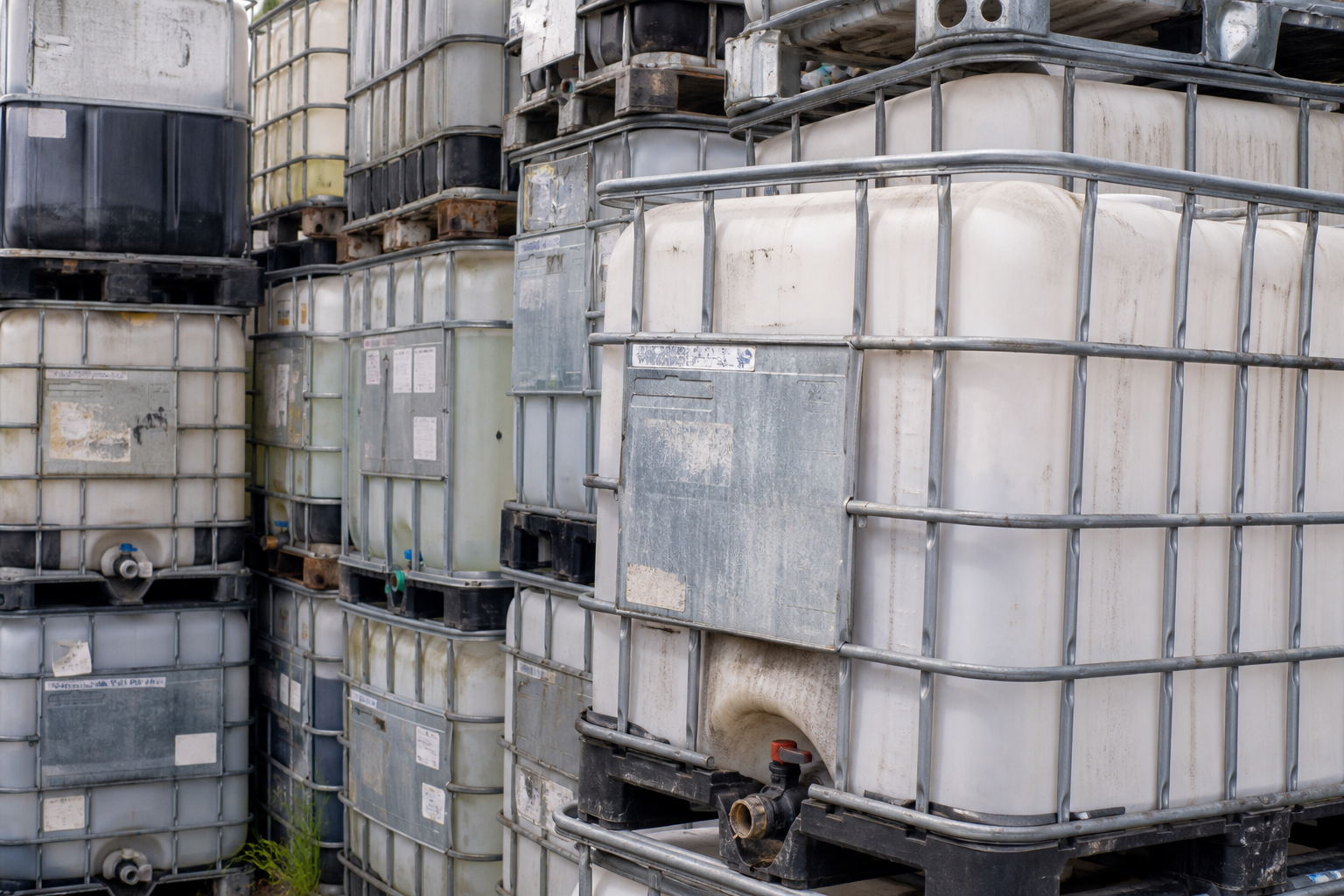
Why viscous products fight your discharge valve
Many valuable liquids become uncooperative when they cool. Honey crystallizes, epoxy and polyurethane resins thicken toward a solid, waxes set hard, and heavy oils and greases turn sluggish. Inside a 275 or 330 gallon tote, that means the product simply will not flow to the valve, and forcing it risks damaging pumps and fittings while wasting product left clinging to the walls.
The fix is controlled heat. The goal is not to cook the product but to raise it to a temperature where it flows freely and discharges cleanly, then to hold it there long enough to empty the tote. Doing this evenly and gently is the difference between a smooth pour and a scorched, degraded, or foaming mess.
Heating jackets: the most common solution
A heating jacket, sometimes called a tote heater blanket, wraps around the outside of the bottle and warms it through the wall. Jackets are popular because they are simple to fit, cover a large surface area for even warming, and require no contact with the product itself, which keeps the process clean and avoids any contamination risk.
Full wrap jackets that enclose most of the bottle heat fastest and most evenly, while partial or base jackets cost less and suit products that only need modest warming. A jacket with an integrated insulating outer layer both heats and retains, which is the most efficient arrangement. Because the heat is applied to the exterior, jackets are gentle by nature, though a good thermostat is still essential to prevent hot spots against the wall.
Base band heaters and immersion heaters
Two other methods handle specific situations. A base or band heater warms from below or around a lower section, which is useful when you mainly need to keep the valve area and lower product fluid enough to start a discharge. It is a lower cost option but heats less evenly than a full jacket, so it suits products that are only mildly viscous.
An immersion heater goes directly into the product through a top fitting and warms from the inside, which is the fastest method for stubborn, high viscosity contents. The trade off is that it contacts the product, so it must be compatible and clean, and it carries a higher risk of localized overheating right at the element. Immersion heating demands careful thermostat control and is best reserved for products that tolerate direct heat.
Matching the method to the product
There is no single right heater; the correct choice follows the product and its sensitivity to heat. The following pairings are a practical starting point.
- Honey: a full wrap jacket with gentle, even heat to reflow crystals without scorching or darkening.
- Epoxy and polyurethane resins: an insulated jacket held at the supplier's recommended handling temperature to reduce viscosity without triggering cure.
- Waxes and paraffins: a jacket or base heater sized to melt fully, since partial heating leaves solid plugs at the valve.
- Heavy oils and greases: base band or partial jacket heating is often enough to restore flow.
- Highly stubborn or fast setting products: an immersion heater for speed, with tight temperature control.
Thermostats and safe temperature control
Every heating method needs a thermostat, and this is not optional. Without closed loop temperature control, a heater will keep adding energy until something is damaged, whether that is a scorched product, a warped bottle, or a fire risk. A thermostat with an accurately placed sensor holds the product at a target range and cuts power once it is reached.
Heat gently and allow time. Blasting a cold, crystallized tote with maximum heat overheats the outer layer while the core stays solid, degrading the product near the wall. A moderate set point held over several hours or overnight produces a uniform, flowable result. Always work within the temperature limits of both the product and the HDPE bottle, since polyethylene softens well below the point where many people assume plastic is safe.
The overlooked role of insulation
Insulation does two jobs that quietly save money. First, it makes heating dramatically more efficient by trapping the warmth you have paid to add rather than letting it bleed into a cold warehouse or a winter yard. Second, an insulated tote holds usable temperature far longer after the heater cycles off, which reduces run time and can keep a product flowable through a workday without constant reheating.
Insulating covers and jackets that enclose the top and sides make the biggest difference, since a large share of heat escapes upward. For operations that store viscous products through cold seasons, insulation alone can cut energy use meaningfully and protect product quality by avoiding repeated heat and cool cycles that stress sensitive chemistries.
Protecting the tote as a reusable asset
Gentle, well controlled heating is also asset care. Overheating warps and weakens the HDPE bottle, shortening the life of a container you intend to reuse many times. Treat the temperature limits as protecting your investment, not just the product inside it. A tote that is heated correctly stays sound and keeps cycling through your operation.
That reuse is where the economics and the sustainability line up. Keeping a tote in service across many fills is far cheaper and lower waste than replacing damaged units, and correct heating and insulation are part of what makes long service life possible.
Sourcing totes and equipment guidance
If you handle honey, resin, wax, or other viscous products and need totes suited to heated service, or you want to talk through a heating and insulation approach for your product, we are glad to help. IBC Tote Solutions supplies and reconditions totes from Berea, Ohio and can advise on units that hold up to repeated warm discharge.
Send your product details and volumes through our quote form or to info@ibctotessolutions.com and we will help you set up a clean, efficient handling process.