Freight is the real cost of a tote
The purchase price of a tote is often smaller than the cost to move it. Because a tote is bulky, planning freight well is where you save real money, whether you are receiving reconditioned units or shipping out empties for resale. It starts with the dimensions.
Get the footprint, height and weight right, and you can predict exactly how many totes fit and whether space or weight will cap your load.
Standard tote dimensions
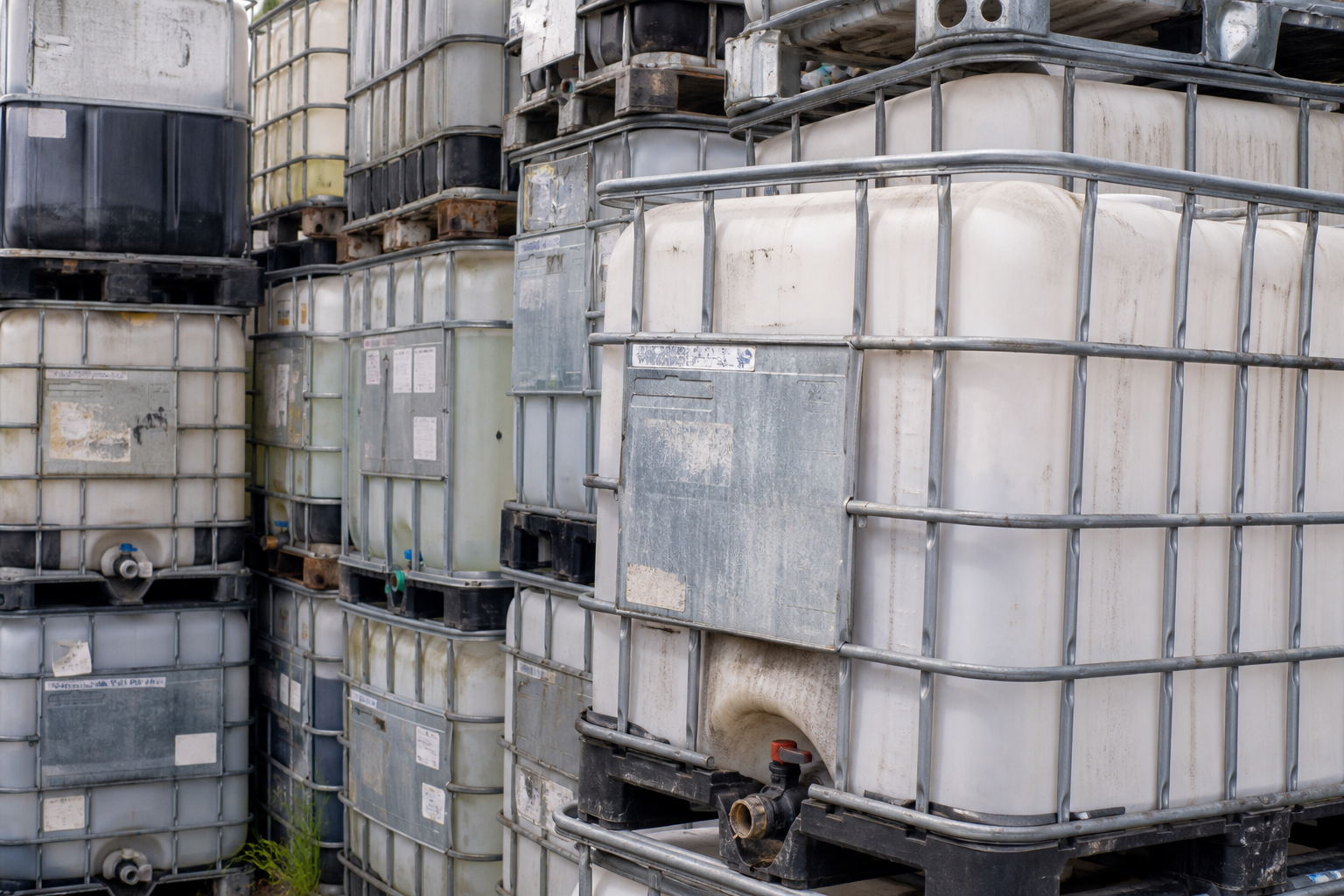
Most 275 and 330 gallon totes share a common footprint designed to match standard pallet handling. Small variations exist between manufacturers, so confirm the exact spec for your units, but the typical numbers are consistent enough to plan around.
These are the figures that drive every freight calculation.
- Footprint: roughly 40 by 48 inches, matching a standard pallet.
- Height: about 46 inches for a 275 gallon and around 53 inches for a 330 gallon.
- Empty weight: commonly 120 to 150 pounds depending on build.
- Filled weight: around 2,300 to 2,600 pounds for water at 275 gallons, more for denser products.
How many fit in a 53 foot trailer
A 53 foot dry van has about 636 inches of usable length and roughly 98 to 100 inches of interior width. Placed on the 40 by 48 inch footprint, totes can be oriented to fit two across, and the exact count depends on which dimension faces the trailer wall.
Single high, a 53 foot trailer typically holds in the range of 26 to 30 totes depending on orientation and how tightly they load. Floor space, however, is rarely the binding constraint for filled totes.
Weight almost always wins
A standard trailer's legal payload is usually around 44,000 to 45,000 pounds. Do the math on filled totes and the ceiling is obvious: at roughly 2,500 pounds each, you reach the weight limit at about 17 or 18 filled totes, well before the floor is full.
That is why filled shipments are weight limited and empty shipments are space limited. Understanding which regime you are in tells you whether to optimize for cube or for pounds.
- Filled totes: expect roughly 17 to 18 units before hitting weight caps.
- Empty totes: floor and height limited, so double stacking multiplies your count.
- Always verify axle weights and gross vehicle limits, not just total payload.
- Denser products lower the tote count further, so calculate with your actual liquid weight.
Double stacking empties
Empty totes are light, so freight for empties is all about cube. Because empties are structurally lighter, they are generally shipped single high loaded, since stacking empty on empty risks crushing the lower bottles, but sturdy cages and careful loading can sometimes allow limited stacking.
The practical win for empties is consolidating volume. A full trailer of empties collected in one stop is dramatically cheaper per unit than scattered small pickups, which is exactly why buyers pay more for palletized quantity in one location.
LTL versus FTL
For a few totes, less than truckload shipping shares a trailer with other freight and you pay by space, weight and class. For larger quantities, full truckload gives you a dedicated trailer and better per unit cost. The crossover point depends on distance and lane, but volume almost always favors FTL.
LTL adds handling, since totes may be transferred between terminals, which raises the risk of damage to cages and valves. For fragile or high value totes, a dedicated or shrink wrapped load reduces that risk.
Loading, securing and protecting the load
However you ship, secure the load so totes do not shift. Filled totes carry huge momentum, and a shifted load is both a damage and a safety hazard. Block, brace and strap according to the carrier's requirements, and protect valves from being crushed against trailer walls.
Confirm the pickup and delivery details up front: dock height or ground level, forklift availability, gate hours and whether a 53 foot trailer can physically reach the staging area. Clear logistics prevent failed pickups and reconsignment fees.
Plan the freight, protect the margin
Sound freight planning is mostly arithmetic once you know the dimensions and weights. Decide whether your load is weight or space limited, consolidate volume, choose LTL or FTL accordingly, and secure the load properly, and you keep the biggest cost of tote ownership under control.
IBC Tote Solutions transports totes and can quote freight on buys and sells, consolidating pickups to cut your per unit cost. Send your quantity and locations through our quote form or email info@ibctotessolutions.com.