The problem the IBC was invented to solve
For most of the industrial era, bulk liquids moved in two awkward extremes. Small quantities went in 55 gallon steel drums, which are heavy, tip prone, and slow to fill and empty at volume. Large quantities went in rail cars or tank trucks, which only make sense when you are moving thousands of gallons at once. Anyone shipping a few hundred gallons faced a poor choice between handling dozens of drums or committing to tanker logistics they did not need.
That middle ground is exactly what the intermediate bulk container was created to occupy. The word intermediate in the name is literal: the format sits between the drum and the tank, giving manufacturers a way to move roughly the contents of five drums in a single palletized, forklift ready unit.
Early forms: rigid boxes and metal bins
The first generation of intermediate containers, appearing through the 1950s and 1960s, were often rigid metal or heavy plastic bins and pallet boxes. Some were essentially large tote bins for powders and granular material rather than liquids. They proved the concept that a stackable, machine handled bulk unit could speed up warehouse and production flow, but they were expensive, heavy when empty, and not always designed for return and reuse.
Flexible intermediate bulk containers, the woven bulk bags used for dry goods, developed along a parallel track and remain common for powders and aggregates. The liquid handling branch of the family, however, was still searching for a design that combined strength, light tare weight, and low cost.
The composite breakthrough
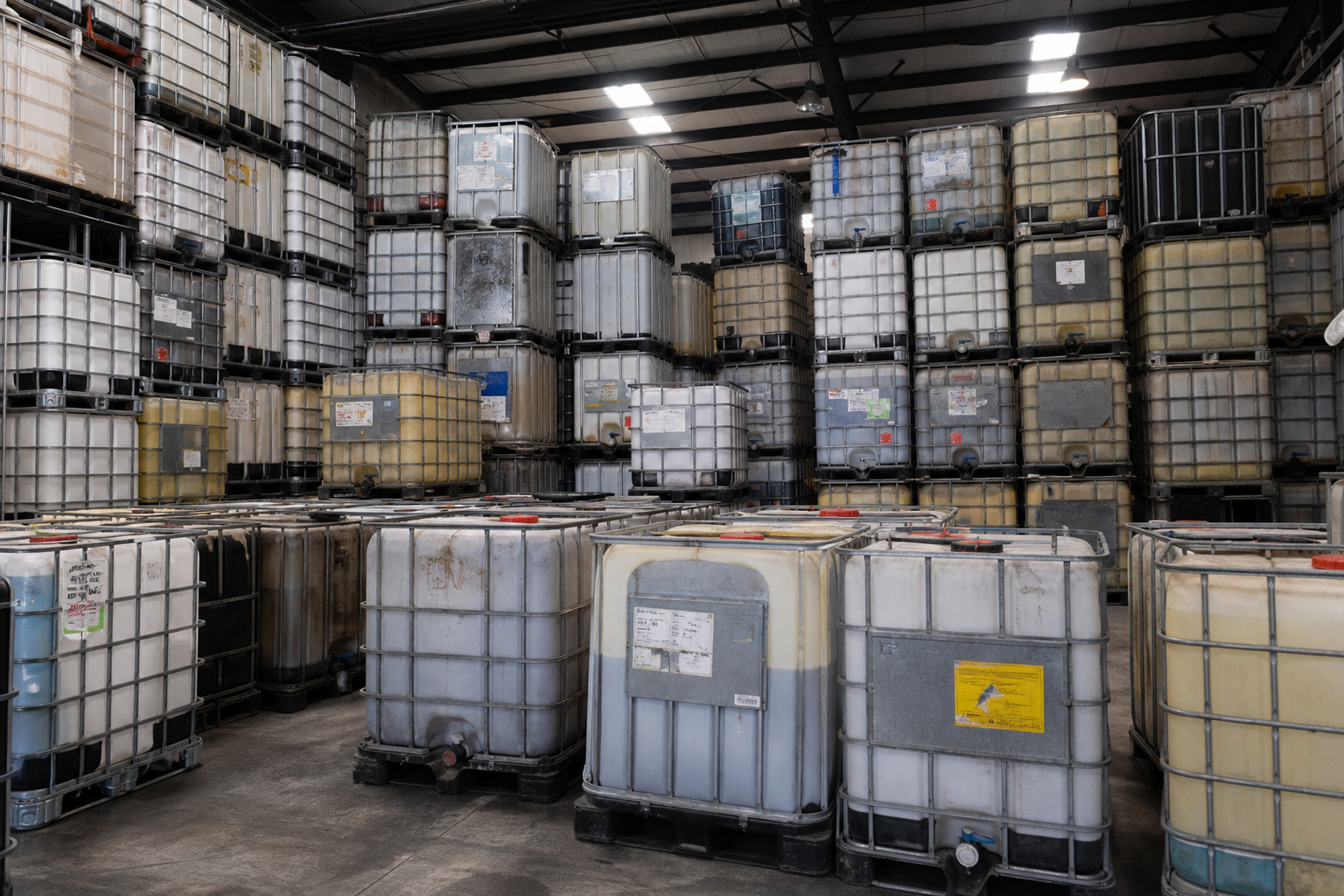
The design that came to define the modern tote is the composite IBC: a blow molded high density polyethylene bottle cradled inside a welded tubular steel cage, mounted on a pallet base with an integrated discharge valve. This arrangement, refined through the 1970s and 1980s, solved the trade off that stumped earlier formats. The plastic bottle is chemically resistant and cheap to produce, the steel cage carries the structural load and allows safe stacking, and the pallet base makes the whole unit forklift and pallet jack ready out of the gate.
Just as important, the composite tote is repairable and reusable. A damaged bottle can be replaced within a sound cage, valves and fittings swap out, and the entire unit can be cleaned and returned to service many times. That reusability is what eventually made the tote both the economical and the environmentally sensible choice over one way packaging.
Why 275 and 330 gallons became the standard sizes
The two dominant volumes did not arise by accident. They are the sizes that align cleanly with the pallet, the forklift, and the truck. A 275 gallon tote and a 330 gallon tote both sit on a footprint close to 40 by 48 inches, matching the standard North American pallet, so they load into trailers and onto racking without wasted space.
The height and weight also matter. A filled tote must stay within safe lift capacities and remain stable when stacked, and it must let a trailer reach a legal payload without leaving cube unused. The common sizes hit those constraints together.
- Footprint matches the standard pallet so units interlock in trailers and on racks.
- Volume equals roughly five 55 gallon drums, a practical replacement ratio for existing drum users.
- Filled weight of many water like products stays within routine forklift lift ranges.
- Two stacked totes fit common warehouse rack and trailer door clearances.
Standardization and the role of transport regulations
A tote is only interchangeable if everyone builds and tests it to the same rules. The United Nations model regulations for the transport of dangerous goods, adopted into regional frameworks and enforced in the United States through the Department of Transportation, gave the industry a shared language. UN marking on a tote records the design type, the materials, the year of manufacture, and the testing it passed for stacking, drop, and pressure.
This certification framework did for the IBC what container standards did for ocean freight. Once a tote carried a recognized UN marking, a shipper, a carrier, and a receiver anywhere could trust its rated performance. Retest and requalification intervals were defined, which is why reconditioners inspect, pressure test, and re mark units before returning them to hazardous service.
The tote as an environmental turning point
The reusable composite tote quietly changed the math of industrial packaging. A single tote that cycles through cleaning and reconditioning dozens of times displaces a mountain of single use drums and pails, along with the steel, plastic, and freight those would have consumed. As sustainability moved from a nice to have to a procurement requirement, the tote's reusability became a headline advantage rather than a footnote.
This is where reconditioning became an industry of its own. Cleaning, testing, repairing, and re certifying used totes keeps durable assets in circulation and is far cheaper for buyers than purchasing new. The greenest tote is almost always the one already built.
Where the format is heading
The core design has proven remarkably stable, but refinements continue. Antistatic and conductive bottles serve flammable liquids, foil and specialty liners extend shelf life for sensitive products, and improved valve and fitting standards speed dispensing. Track and trace tagging is making closed loop return programs easier to run at scale, so more totes come back for reuse instead of drifting out of the system.
What has not changed is the fundamental value proposition that launched the format: move a useful mid range volume of liquid safely, efficiently, and repeatedly.
Buying, selling, and keeping totes in service
Understanding this history explains why a used tote is such a strong buy. You are purchasing a mature, standardized, repairable asset that was engineered from the start to be used again and again.
IBC Tote Solutions works within that reuse economy every day, buying, selling, reconditioning, transporting, and recycling totes from Berea, Ohio. Whether you want to sell surplus units or acquire tested totes for your operation, reach us through our quote form or at info@ibctotessolutions.com.