The Two Sizes That Dominate the Market
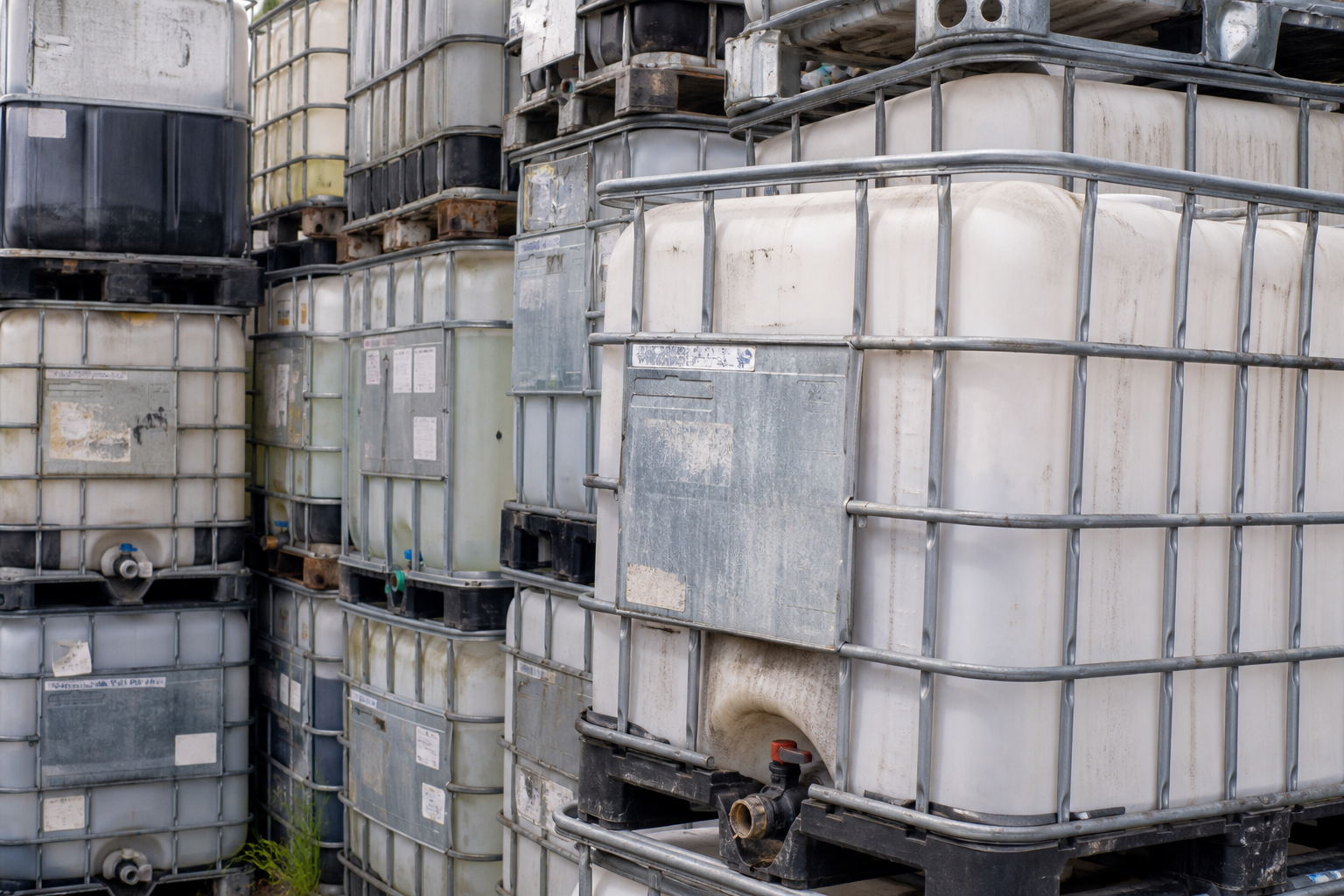
If you have shopped for intermediate bulk containers, you have almost certainly run into two numbers over and over again: 275 gallon and 330 gallon. These are the workhorses of the IBC world, and for good reason. They hit the sweet spot between the handling convenience of a drum and the volume efficiency of a bulk tank, and they both ride on a standard pallet footprint that plays nicely with forklifts, pallet jacks and truck decks.
The confusing part is that on paper these two containers look almost identical. Same cage style, same HDPE bottle construction, same discharge valve, same 40x48 inch pallet base. So why would you pick one over the other? The answer lives in the details of weight, height, product density and freight, and getting it right can save you real money over the life of the container.
Footprint Is Identical, Height Is Not
Here is the first thing that surprises new buyers: the 275 and 330 gallon totes share the exact same 40x48 inch footprint. That means neither one takes up more floor space than the other. Whatever aisle, rack or truck lane fits one will fit the other.
Where they differ is height. A 275 gallon tote typically stands around 46 inches tall, while a 330 gallon tote is closer to 53 inches. That extra seven inches or so matters a great deal in facilities with low door clearances, mezzanine shelving, containment berms, or spray booths. It also matters when you plan to stack. If your ceiling or racking limits you to a certain stack height, the shorter 275 may let you go two high where the 330 would not.
- Footprint (both sizes): 40 x 48 inches, standard pallet base
- 275 gallon height: roughly 46 inches
- 330 gallon height: roughly 53 inches
- Empty weight: both usually 120 to 150 pounds depending on cage and pallet material
Weight Is Where Density Decides For You
Volume is only half the story. What actually loads the pallet, the forklift and the truck deck is weight, and weight depends on what you are storing. Water weighs about 8.34 pounds per gallon, so a full 275 gallon tote of water is roughly 2,290 pounds of liquid, and a 330 gallon tote is about 2,750 pounds. Add the container tare and you are looking at container gross weights well over 2,400 and 2,900 pounds respectively.
Now factor in density. Many industrial fluids, concentrated cleaners, and certain food ingredients are heavier than water. If your product runs 10 or 12 pounds per gallon, a full 330 gallon tote can push past 4,000 pounds. That can exceed the safe working load of a light-duty pallet jack, strain older racking, and complicate stacking. For dense products, the 275 keeps individual container weight in a more manageable range.
Freight and Trailer Math
Freight is often the hidden decider. A standard 53 foot dry van holds a fixed number of pallet positions, and both totes occupy one position each. So on a pure per-position basis, the 330 gives you more gallons per pallet slot, which sounds like an automatic win.
But trucks are limited by weight as well as space. A typical over-the-road trailer maxes out around 43,000 to 45,000 pounds of payload. With dense liquids, you will hit that weight ceiling long before you fill the trailer floor. In that scenario the extra volume of the 330 is wasted because you cannot legally load more of them. The 275, being lighter per unit, can sometimes let you fit more total units and better use the trailer.
The rule of thumb: for light fluids near the density of water, the 330 wins on freight efficiency. For heavy fluids, the 275 often lets you load the same or more weight while staying under axle and gross vehicle limits.
When Each Size Clearly Wins
Reach for the 275 gallon tote when you handle dense or heavy products, when overhead clearance is tight, when you rely on light-duty material handling equipment, or when you want to stack two high under a lower ceiling. It is also the friendlier choice for smaller operations that do not want to move nearly 3,000 pounds at a time.
Reach for the 330 gallon tote when you move high volumes of lighter liquids like water-based solutions, when you want to reduce the number of container changeovers and connections, and when your freight is space-limited rather than weight-limited. Fewer, larger containers mean fewer valve hookups, fewer labels and fewer handling cycles.
Reconditioned Totes Change the Cost Equation
Whichever size you choose, buying reconditioned instead of brand new can cut your per-container cost dramatically while keeping a perfectly serviceable HDPE bottle and galvanized steel cage in circulation. A reconditioned tote has been emptied, cleaned, inspected, pressure or leak tested as appropriate, and fitted with a sound valve and gasket. For the vast majority of non-critical storage and transfer jobs, a quality reconditioned unit performs the same as new at a fraction of the price.
There is a sustainability payoff too. Every reused tote keeps roughly 120 to 150 pounds of HDPE and steel out of the recycling and manufacturing cycle and displaces the energy that would go into making a new one. Choosing reused is one of the simplest circular-economy wins available in bulk packaging, and it is often the smarter financial call on top of the environmental benefit.
Let Us Help You Match the Right Tote to the Job
Still not sure whether your operation calls for 275 or 330 gallon totes, new or reconditioned, food grade or industrial? Tell us your product, its density, your clearance and your freight setup, and we will point you to the right fit. Send the details through our quote form or email us at info@ibctotessolutions.com and we will get you sorted.